


How Debt–Equity Rules Impact Taxpayers’ Transfer Pricing Risk
A lot of transfer pricing risks in intercompany financing arise at the moment a company determines whether the arrangement should be treated as debt or equity.
This initial debt-equity classification influences interest treatment, the assumptions behind repayment, and the way financial capacity is evaluated during a tax audit. As authorities place greater attention on the substance of funding structures, the risk of adjustments increases when form and economic reality do not align.
Recharacterization can impact deductions, cause inconsistencies across reporting periods, and lead to significant transfer pricing corrections.
To prevent this, many multinational groups rely on accurate and consistent transfer pricing documentation, ensuring that their financing arrangements are supported by clear analysis, robust evidence, and compliance with current expectations.
Why classification drives risk, and why the stakes are high
The classification of intercompany funding is not just a technical formality. It defines how tax authorities will view every other part of the arrangement.
Once a transaction is classified as debt, the group assumes that an independent lender would have provided funding under similar conditions. From that point forward, every assumption must be consistent with and support that claim.
This one decision establishes the analytical framework for the entire structure. Interest rates, repayment schedules, covenants, guarantees, and monitoring mechanisms are all evaluated through the same perspective: would a third party have accepted this risk on these terms, considering the borrower’s financial position and the surrounding market conditions?
How the initial classification shapes the entire structure
When a transaction is treated as debt, tax authorities expect to see proof of repayment ability from the start, not just hope for future performance.
They examine the borrower’s cash flows, leverage, business model, and ability to handle downturns as they were at the time the loan was approved. Authorities do not look at the transaction by itself; they consider it in the larger commercial context.
In practice, this means reviewing:
- the borrower’s historical and projected financial performance,
- the purpose of the funding and how it supports value creation,
- prevailing market conditions at the time of issuance, and
- how the parties actually behaved over the life of the instrument.
If these factors do not support the idea that repayment was expected from the beginning, the structure remains weak no matter how well it is documented later.
Issues from the start cannot be fixed afterward. Better documentation does not change the fact that the original decision lacked economic backing.
Why early misjudgments cannot be repaired later
A common misconception is that documentation can make up for business weakness.
In reality, tax authorities focus on whether the original decision was reasonable when it was made. If the borrower was already financially limited, highly leveraged, or reliant on continued group support, the debt classification is questioned at its core.
Once such doubt appears, subsequent compliance efforts have little persuasive value. Authorities are not convinced by refined comparisons or changed terms if the underlying assumption – that an independent lender would have provided the funds – does not hold.
How one weak assumption affects the MNE
When a loan starts to look like equity in its economic essence, every transfer pricing element based on it becomes unstable.
Pricing discussions lose importance because the instrument itself no longer counts as debt. Interest rates, margins, and comparables become less important considerations.
Reclassification has broad effects. It usually involves:
- reassessing prior years,
- restating intercompany balances,
- reallocating profits and capital, and
- examining historical behavior across the group.
The impact grows when multiple entities are involved. A single misclassified loan can disrupt cash flows, capital allocation, and profit distribution across different jurisdictions. Corrections made in one country often lead to audits or adjustments in another country, turning a local problem into a group-wide risk.
For multinational groups, classification mistakes rarely stay limited. Once trust is lost, authorities start to question not just the transaction in question but also the consistency of the group’s overall funding story.
Where companies usually go wrong in intercompany financing
The classification of intercompany funding is often seen as a technical step, but it is one of the most important decisions a company makes. When this classification fails, the entire structure often collapses.
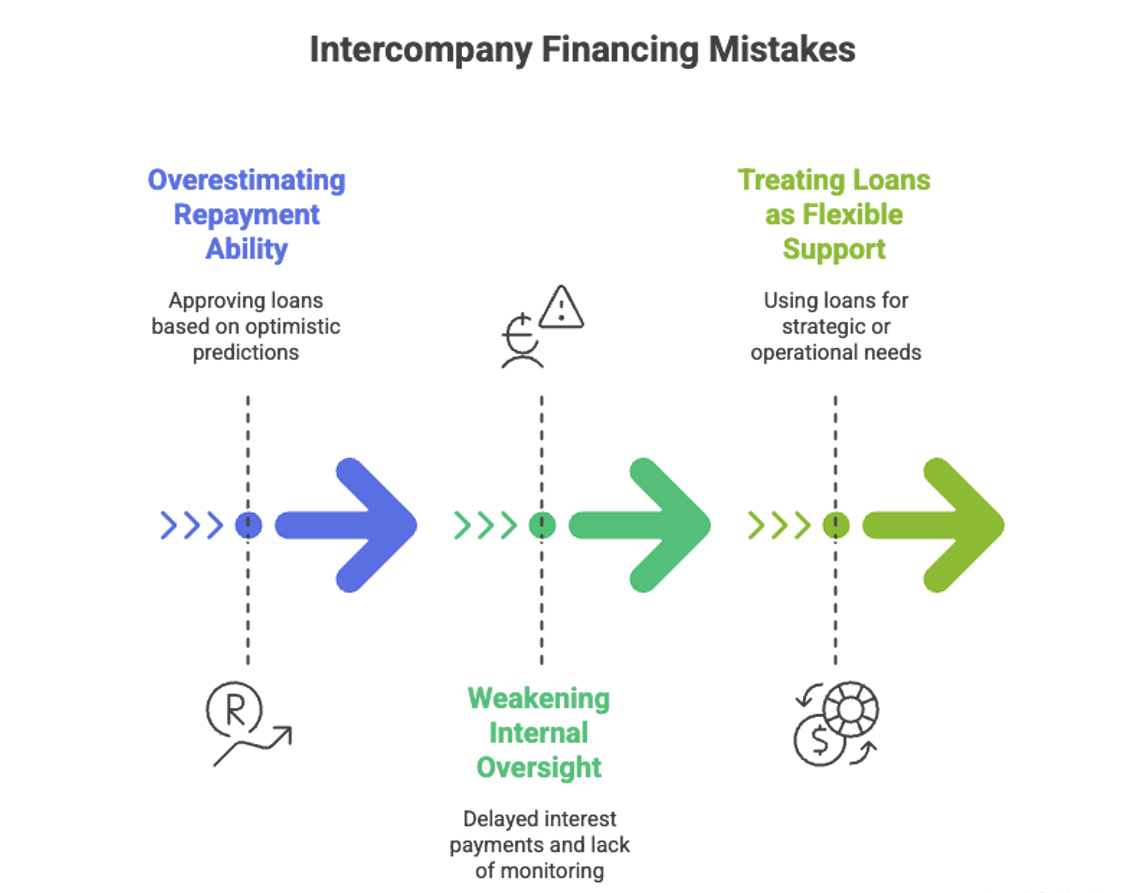
Overestimating repayment ability
A common mistake is approving loans based on optimistic predictions instead of tested financial models. Borrowers might expect increasing revenue, better margins, or enhanced efficiency, which seem promising but are uncertain.
When actual performance doesn’t match these expectations, tax authorities decide that repayment was never feasible. This conclusion is hard to dispute because it shows the gap between hopes and real-world conditions.
Letting financial oversight fade
A second pattern involves the weakening of internal creditor discipline. Delayed interest payments, waived covenants, or the lack of regular monitoring all show that the lender does not act like a true financial partner.
These behavior issues build up over time. By the time the loan comes under audit scrutiny, the evidence shows a pattern of leniency rather than proper creditor behavior. Authorities do not need to find one major failure; a series of small inconsistencies is often enough.
Treating internal loans as flexible support
In many groups, internal loans meet strategic or operational needs instead of strict commercial ones. This makes sense from a management viewpoint, but it creates issues from a transfer pricing perspective. Extensions of repayment terms, repeated deferrals, or changes to interest without a clear reason indicate that the arrangement mainly serves as supportive capital.
When a loan starts to act like equity, auditors question why it shouldn’t be classified that way. The more flexibility the borrower has, the more difficult it is to defend the original structure.
How tax authorities approach debt and equity analysis today
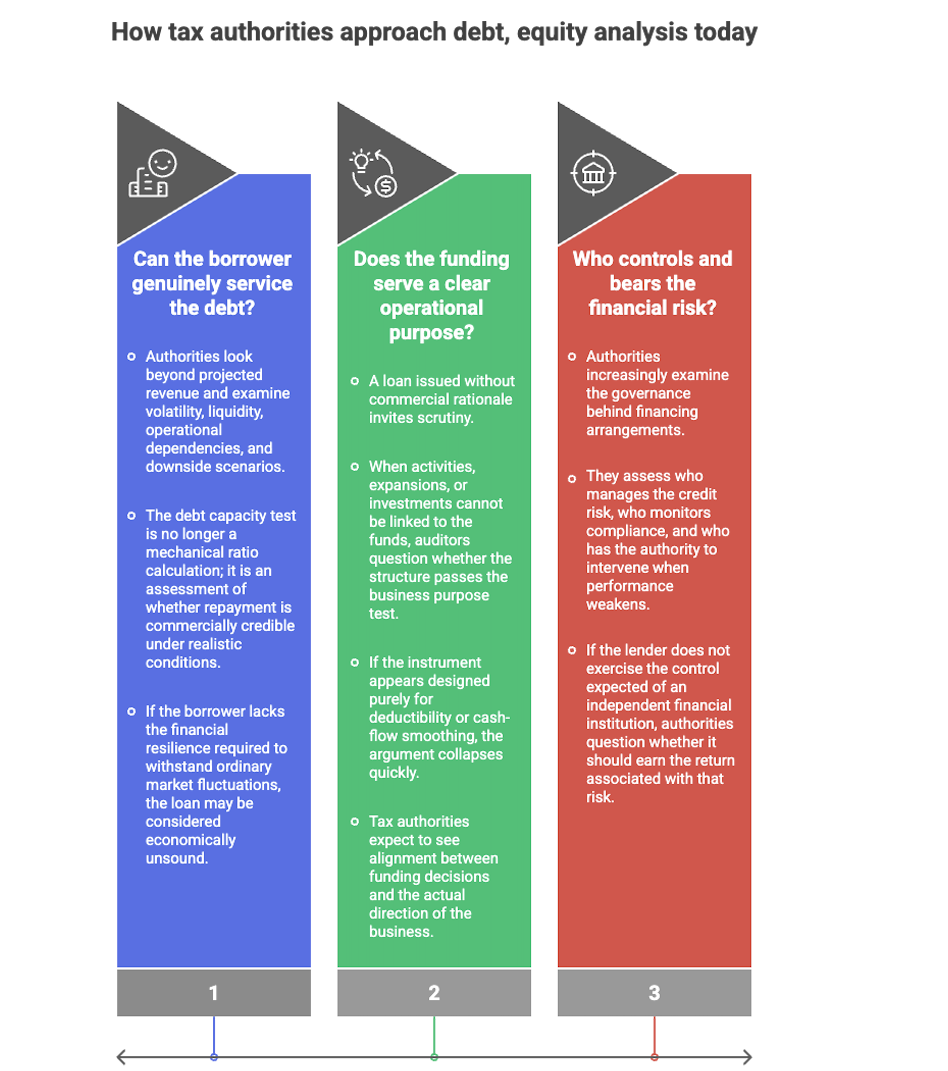
Audits of financing transactions have become much more advanced. Authorities no longer focus only on contractual terms; they also look at how a transaction works in real life. Their evaluation usually centers on three main questions:
1. Can the borrower genuinely service the debt?
Authorities look beyond projected revenue and examine volatility, liquidity, operational dependencies, and downside scenarios. The debt capacity test is no longer a mechanical ratio calculation; it is an assessment of whether repayment is commercially credible under realistic conditions.
If the borrower lacks the financial resilience required to withstand ordinary market fluctuations, the loan may be considered economically weak.
2. Does the funding serve a clear operational purpose?
A loan issued without economic rationale invites scrutiny. When activities, expansions, or investments cannot be linked to the funds, auditors question whether the structure passes the business purpose test.
If the instrument appears designed purely for deductibility or cash-flow smoothing, the argument collapses quickly. Tax authorities expect to see alignment between funding decisions and the actual direction of the business.
3. Who controls and bears the financial risk?
Authorities increasingly examine the governance behind financing arrangements. They assess who manages the credit risk, who monitors compliance, and who has the authority to intervene when performance weakens.
If the lender does not exercise the control expected of an independent financial institution, authorities question whether it should earn the return associated with that risk. Weak governance, therefore, harms both pricing and classification.
How a single classification decision alters transfer pricing outcomes
Debt and equity create different tax impacts. When authorities deny the debt claim, the whole pricing structure loses its significance. Interest is no longer deductible, adjustments take effect retroactively, and funding positions across the group need reassessment.
A change of classification also disrupts the basis for applying the arm’s-length principle, which lies at the centre of transfer pricing.
If a transaction is not recognized as debt, then comparisons lose significance. Authorities may even extend their review to other instruments that have similar features, such as guarantees, hybrid structures, or layered loans.
Some financing structures draw quicker attention than others:
- arrangements where leverage levels sharply exceed industry norms;
- borrowers with volatile earnings or limited control over revenue generation;
- lending entities that lack personnel capable of monitoring credit risk;
- loans issued without covenants, security, or repayment triggers.
Each of these signals indicates behaviour inconsistent with market practice. The more such indicators accumulate, the more likely authorities will test the substance of the transaction rather than accept its form.
The global direction of funding rules
In the case of funding, the landscape is changing. Previously, funding structures could operate independently of market realities, governance, and standards. Now, they are slowly coming together around a common agreement.
Financial backing must be supported by real economic viability, good governance, and ethical conduct that aligns with market principles.
Growing convergence around substance and governance
International practice increasingly centres on behavioural evidence rather than contractual form. Independent lenders expect discipline, monitoring, and enforceability. Tax authorities now apply the same expectations. If internal practices diverge from market standards, pricing becomes secondary – the structure itself becomes questionable.
Enhanced data analysis and cross-border information exchange
Tax administrations now have access to more comparable data than ever before. Information from country-by-country reporting, public filings, and external commercial databases allows auditors to detect inconsistencies quickly. Patterns such as persistent losses combined with rising debt, or sudden increases in related-party financing, often trigger deeper reviews.
Pressure on inconsistent funding narratives
Authorities increasingly compare how entities explain their financial behaviour across jurisdictions. If one entity claims to be financially constrained while another describes the group as cash-rich, credibility erodes. Funding must align not only with economic logic but also with the broader operational strategy of the multinational group.
How companies can reduce transfer pricing risks in funding structures
Reducing exposure in intercompany financing is rarely about adjusting a single parameter. In practice, risk builds up over time – through assumptions that are not revisited, documentation that falls out of sync with business reality, or governance that slowly weakens as conditions change.
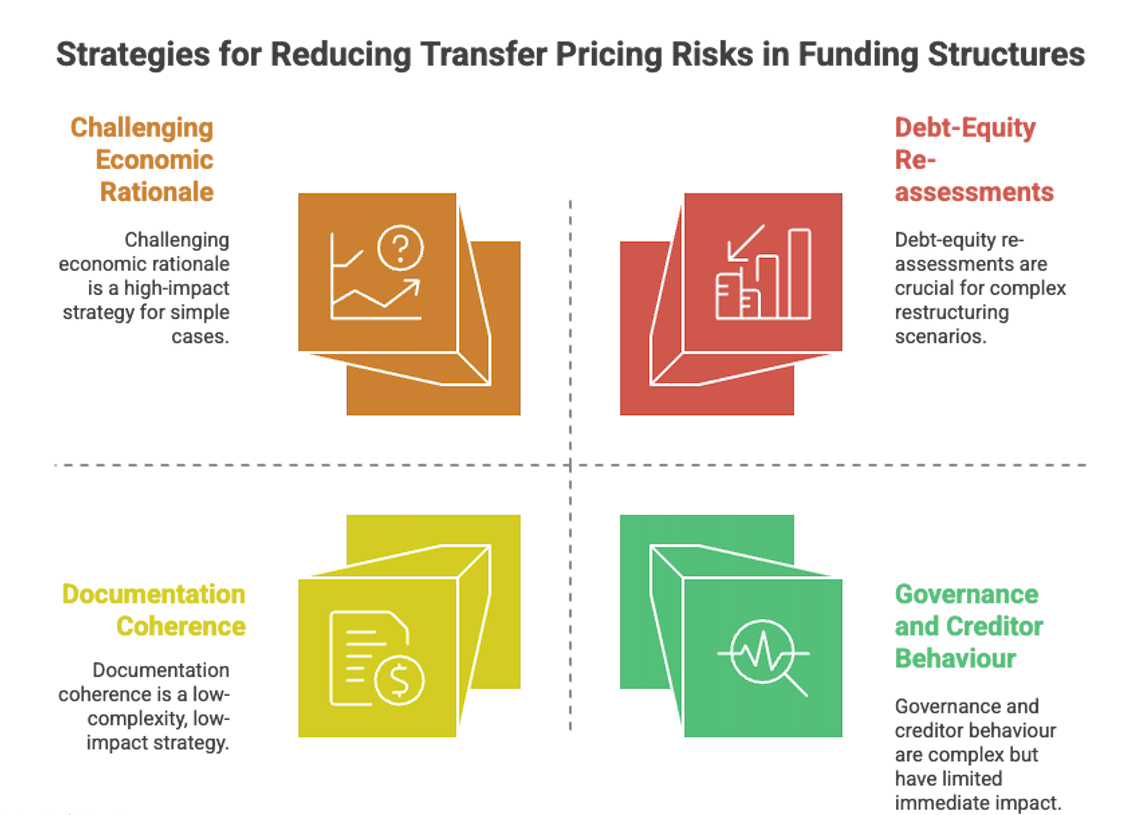 Addressing these risks requires more than technical compliance; it requires a structured review of how the funding actually functions.
A few targeted actions may significantly enhance the defensibility of financing arrangements:
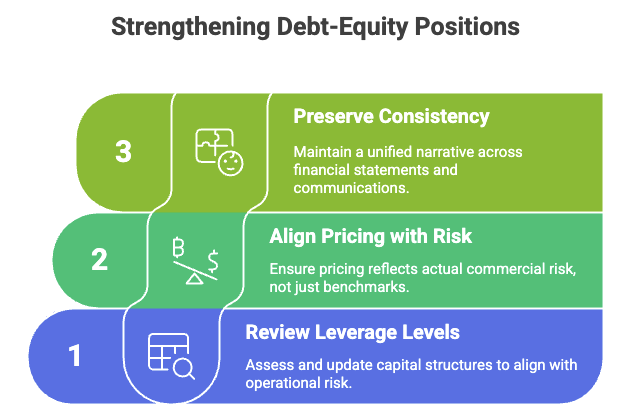
- Review leverage levels in advance of tax cycles. Many borrowers operate with outdated capital structures because leverage is not reassessed regularly.
- Align pricing with actual commercial risk, not theoretical benchmarks. Benchmarking studies are useful but insufficient; authorities expect to see how the pricing reflects your real conditions: default risk, financial discipline, and borrower-specific volatility.
- Preserve consistency across financial statements, agreements, and internal communications. If the story changes depending on the audience, auditors will question the intention behind the arrangement. A straightforward narrative, supported by evidence, is one of the strongest protections.
Strengthening debt–equity positions is not about designing complex instruments – it is about ensuring that the logic behind the funding is transparent, defensible, and consistent with real-world financial behaviour.
A clear funding narrative remains the strongest defence
Risk isn’t really an issue when intercompany financing is well-structured and the commercial basis is clear. However, if the governance is weak and the way the parties operate diverges from what independent lenders would expect, this is when problems arise. Coming from a tax perspective, the lack of substance, incoherence, and financial discipline in intercompany financing makes it increasingly difficult to justify any financial arrangements.
Funding structures that withstand scrutiny are typically built on three foundations: a clearly articulated commercial purpose, realistic repayment expectations, and consistent behaviour throughout the life of the instrument.
FAQ
1. Why is debt and equity classification more important than pricing in intercompany financing?
When considering intercompany financing, classifying debt and equity is much more significant than pricing, as it determines the legitimacy of the transaction, and no interest rate or benchmarking can salvage a transaction that doesn’t have the marks of real debt.
2. Can strong documentation make up for weak economic fundamentals?
Strong documentation is no substitute for sound economic fundamentals; it can’t bail out a company whose financials were unrealistic from the start, and basically, won’t work in a structure that was wrong to begin with.
3. What typically triggers recharacterisation of intercompany loans?
The recharacterisation of intercompany loans is a very common thing and is usually caused by the combination of the borrower’s weak repayment capabilities, irregular creditor actions, and inconsistent stories about the funding.
4. Why do classification errors often escalate into group-wide risks?
Adjustments in one jurisdiction tend to affect profit allocation, capital structure, and audit positions elsewhere, especially when multiple entities are involved in the funding chain.
