


Transfer Pricing: Past, Present, and Future
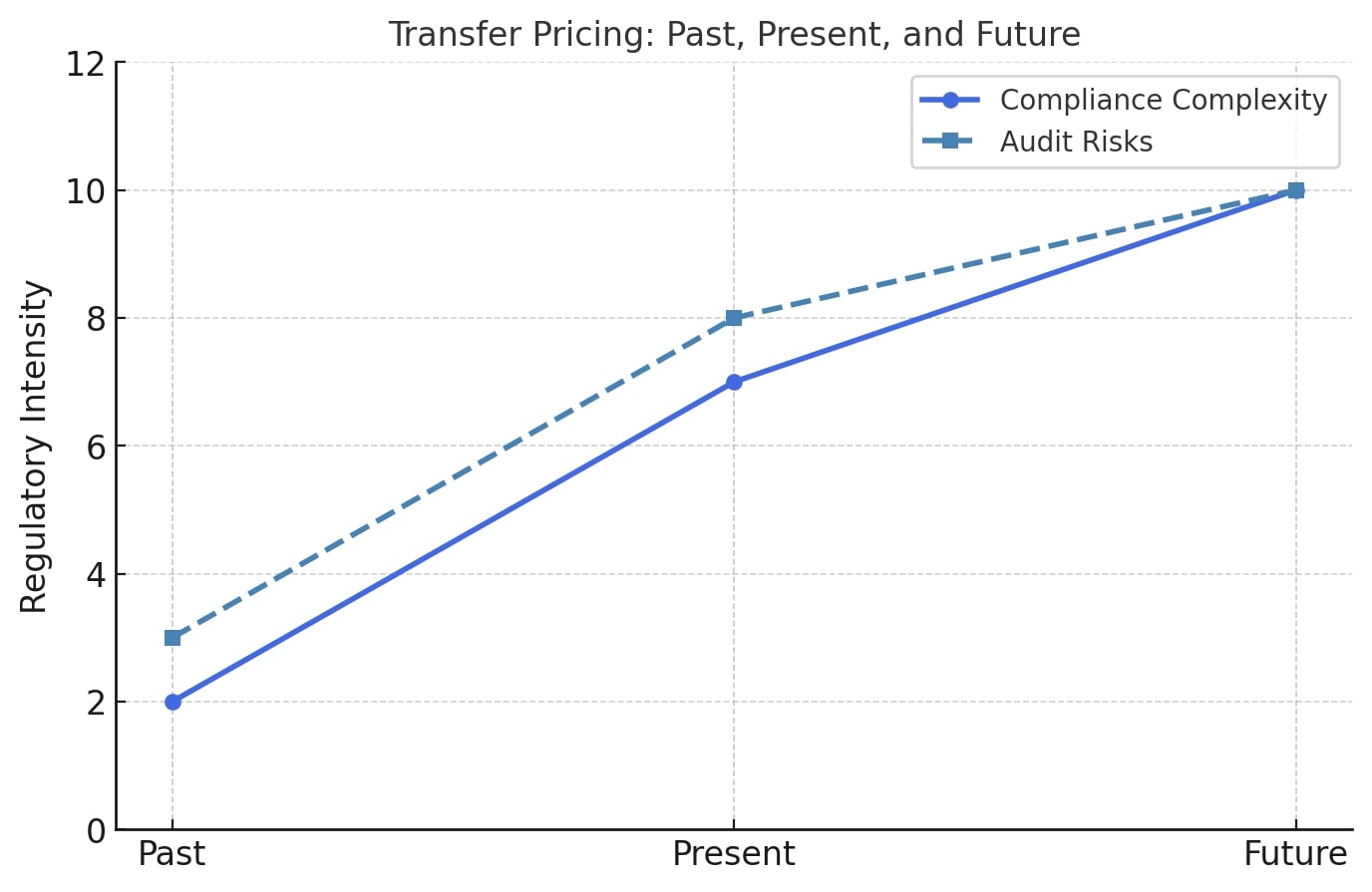 Transfer pricing has always been a primary concern for multinational companies. The concept was relatively simple in the past: determine the price of a product or service sold between subsidiaries. However, as companies went global, governments introduced stricter regulations to prevent tax avoidance. Today, transfer pricing is one of the most challenging areas of international taxation, with rules changing daily, audits escalating, and significant penalties for non-compliance. In the future, the landscape will become much more complicated, with new OECD guidelines, digital taxation, and AI-driven compliance shaping the way companies will manage their tax strategies.Compliance is not a matter of following the book or preparing your business for what comes next. At T1 Advisory, we understand the past, navigate the present, and prepare companies to build future-proof transfer pricing. With the right approach, companies can keep pace with an ever-changing regulatory climate. The key question, of course, is: Is your company ready for what may come next?
The founding of transfer pricing: how it all began
As companies began to expand across borders, a major issue was how to allocate profits fairly among different locations. In the absence of rules, companies were able to price sales between subsidiaries to minimize their overall corporate tax liability and typically shift profits to low-tax jurisdictions. In response, governments began to implement transfer pricing rules to ensure that companies pay tax where the business is actually done.Today, transfer pricing is probably the most scrutinized area of international taxation. Companies must carefully document their pricing decisions to avoid penalties from tax authorities. Ensuring compliance isn’t easy, but transfer pricing documentation services offered by T1 Advisory help companies get it right – reducing risk and keeping operations running smoothly.The early days – why transfer pricing became a global issue
Until the mid-20th century, transfer pricing was not an issue because most companies operated in their home country. As globalization took hold, companies began selling goods, services, and even intangible assets to and from their various subsidiaries around the world. Without regulation, companies could set prices artificially high or low to shift profits to lower-tax locations.The diagnosis wasn’t difficult: corporate tax revenues were being drained while local businesses couldn’t compete. And then countries just started making up their own rules, which could be very contradictory, leading to misunderstandings and lawsuits. A global solution was needed.How OECD guidelines changed the rules of the game
In 1979, the Organization for Economic Cooperation and Development (OECD) issued its first set of transfer pricing guidelines. The guiding principle was the arm’s length principle, or ALP, which meant that prices between related companies should be set as if the parties were completely independent businesses. It prohibited companies from setting prices artificially low or high in order to reduce taxes.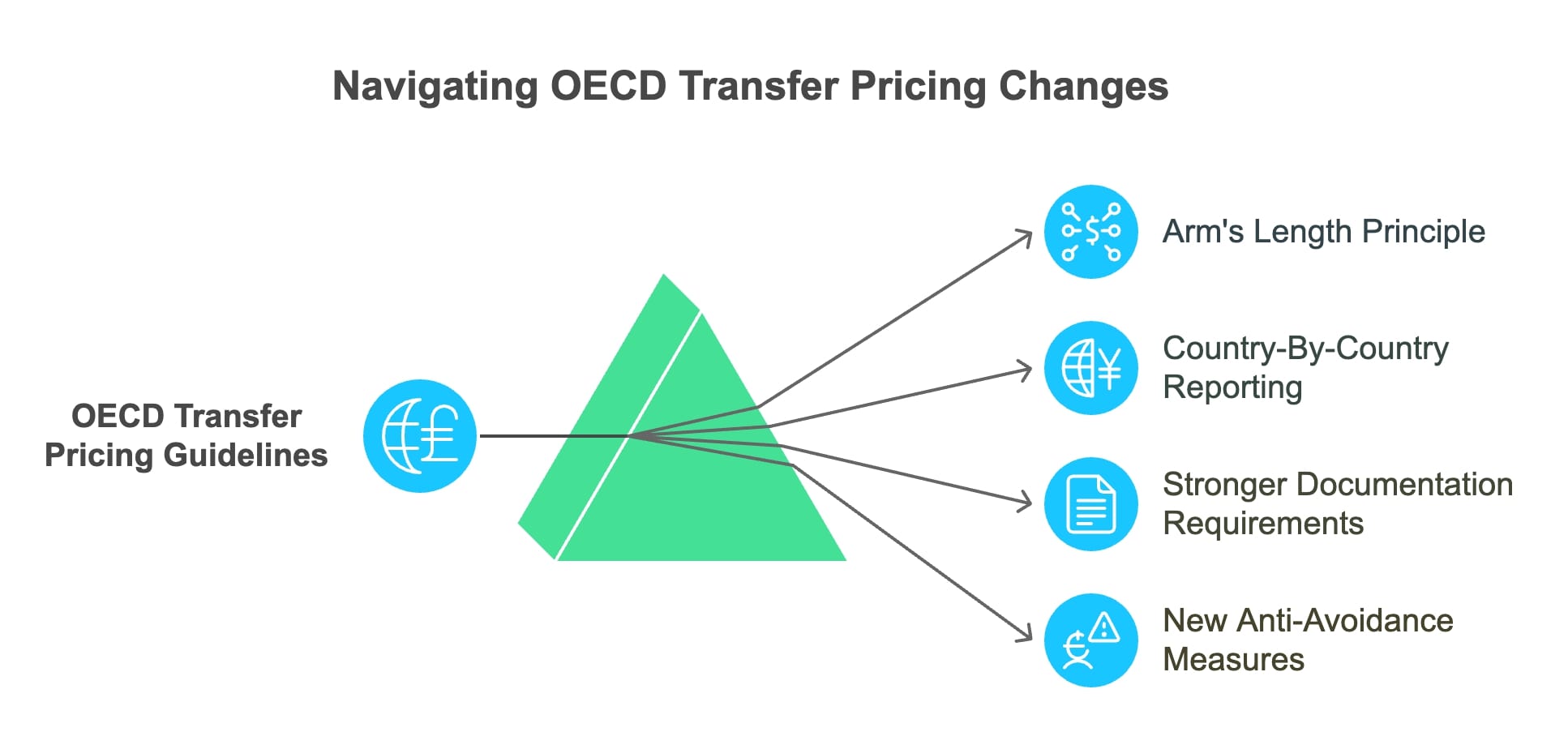 Over time, companies devised more sophisticated ways to avoid taxes, and governments enacted stricter transfer pricing laws. The OECD’s Base Erosion and Profit Shifting initiative, launched in 2013, brought in new rules, including:
- Country-by-Country Reporting (CbCR): Companies must now report their profits and the taxes paid in each country where they operate.
- Stronger documentation requirements: Companies have to be able to prove that the transfer prices adopted are appropriate and reflect real market conditions.
- New anti-avoidance measures: Governments have addressed vulnerabilities that enable firms to shift their profits unfairly.
Major court cases that redefined transfer pricing laws
Transfer pricing rules became even more stringent after several high-profile legal battles. Several governments took major corporations to court for what they called unfair profit shifting:
- GlaxoSmithKline (GSK) vs. Internal Revenue Service (IRS) 2006: $3.4 billion settlement GSK was accused of overcharging its US subsidiary for drugs in an effort to shift profits to the UK. A case that underscores how closely tax authorities are now scrutinizing transfer pricing related to intellectual property and trademarks.
- Apple vs. European Commission, 2020: €13 billion tax bill Apple was accused of using Ireland’s tax system to avoid paying taxes in other EU countries. Although the case was overturned, it set the stage for greater scrutiny of multinational companies’ tax structures.
- Amazon vs. European Commission, 2021: €250 million tax dispute The European Commission ruled that Amazon had received special tax treatment in Luxembourg. Amazon won the case, but the ruling opened up new questions about how digital companies divide their profits between countries.
Today’s transfer pricing landscape: rules, challenges, and compliance
What new OECD guidelines mean for your business
Transfer pricing rules are in a state of constant evolution, and no enterprise can afford to lag. The latest OECD Transfer Pricing Guidelines 2022 emphasize increased transparency, strict compliance, and harsher penalties in case of defaults. These are not mere formality changes: they have substantial financial implications for businesses across the globe.At the center of these updates is the OECD’s BEPS initiative, which is focused on ceasing to let companies shift profits to low-tax countries. This new framework comprising Pillar One and Pillar Two makes sure that businesses pay taxes in those jurisdictions where they do operate, instead of just those jurisdictions where they have registered their profits. If your company crosses borders, here is what you need to know:- Stricter tax enforcement: AI and data-sharing spot red flags across governments.
- More tax audits: Even minor mistakes in documentation often lead to great tax disputes.
- Global minimum tax (Pillar Two): Now, large multinational enterprises need to pay a minimum of 15% taxes in every economy where they would conduct business.
- New digital tax rules (Pillar One): Taxation increasingly shifts to customer locations, rather than company headquarters.
Must-know compliance rules: transfer pricing documentation and reporting
If there’s one thing that has changed dramatically in the transfer pricing world, it’s documentation and reporting requirements. Gone are the days when companies could get by with minimal paperwork and loose justifications for their intercompany pricing. Today, tax authorities demand granular, well-structured, and real-time data to prove that transactions between subsidiaries reflect genuine market conditions.At the core of these requirements is the three-tiered documentation approach introduced by the OECD as part of the BEPS Action 13 framework:- Master File: A global document providing an overview of the entire multinational group’s transfer pricing policies, structure, and financial activities.
- Local File: A country-specific report with detailed justifications for how intercompany transactions are priced and aligned with the arm’s length principle.
- Country-by-Country Reporting: A high-level financial report disclosing revenue, profits, taxes paid, and other key indicators for each country where a company operates.
The biggest challenges companies face and how to overcome them
Transfer pricing is more challenging today than it has ever been, striking a balance among complex tax rules, shifting digital economies, and aggressive enforcement measures. In the EY’s global survey of transfer pricing leaders, 76% are challenged by the volume and complexity of global tax reforms. Companies without a clear strategy invite disputes, financial losses, and failures in compliance. Here’s what companies struggle with and what T1 Advisory experts recommend.| Challenge | T1 Advisory recommends |
| Conflicting international tax laws | Establish the transfer pricing policy of a multinational company in accordance with the regulations to avoid double taxation and disputes. |
| The rise of digital taxation | Apply real-time tax modeling to adapt pricing structures to changed Pillar One rules. |
| Customs vs. transfer pricing misalignment | Combine customs and transfer pricing planning within one strategy to avoid conflicts and minimize unexpected import duties. |
| AI-driven tax enforcement | Automate compliance with early risk detection and maintain audit-ready documentation at all times. |
| Increased scrutiny on intercompany financing | Apply clear, well-documented financing policies, underpinned by economic analysis that justifies the terms of the intercompany loans. |
| Evolving OECD guidelines & frequent regulatory changes | Continuously monitor updates in policies in real time and proactively adapt the pricing models to ensure compliance. |
The digital economy is reshaping transfer pricing – are you ready?
Once a game of physical products and tangible supply chains, it is now a game of cloud servers, intellectual property, algorithms, and data flows – everything exists everywhere and nowhere simultaneously. The digital economy forces tax authorities to redraw the lines on where profit is deemed earned, and those companies that cannot keep up risk facing some of the biggest tax bills in history.Why ecommerce & tech companies face new tax challenges
For a firm that sells tangible goods, justification of where its profits should be taxed is easy: it relates to production and distribution, for example. And what happens in cases when one company’s vital asset is just a data-powered algorithm?Take big tech platforms, streaming services, and SaaS providers alone – they generate revenues from scores of countries without ever setting foot in them. Traditional transfer pricing rules allow them to pay taxes only in the country where they have an office, but that’s just what regulators are trying to change.A new question is being asked by governments: Where is value created? If a company’s revenue is being created by millions of users in one country, does that country have a right to tax those profits even if it has no formal legal presence in the country?This is the battle at the heart of modern transfer pricing. Countries such as France, India, and the UK have already rolled out their digital services taxes, demanding their piece of the action from the profits of digital companies operating on their turf. The redistribution of tax rights based on where a company’s customers are, not where its headquarters sit, gets formalized with the Pillar One initiative of the OECD.How OECD is addressing the digital taxation puzzle
The Pillar One and Pillar Two framework was designed by the OECD to harmonize global tax rules and combat profit shifting in the digital economy. In practice, however, its actual implementation has been slow, with some major players like the US opposing these regulations arguing that such a formula discriminates against American tech companies. Different countries have adopted these rules at different times, creating more confusion for companies. Meanwhile, tax authorities are reaping the benefits of using AI to find inconsistencies using big data, leading to multi-billion dollar tax disputes.Real-life cases: transfer pricing issues in the digital age
The consequences of getting digital transfer pricing wrong are not theoretical – they are already happening. Some of the world’s largest companies are embroiled in major legal battles as regulators refuse to accept outdated tax structures.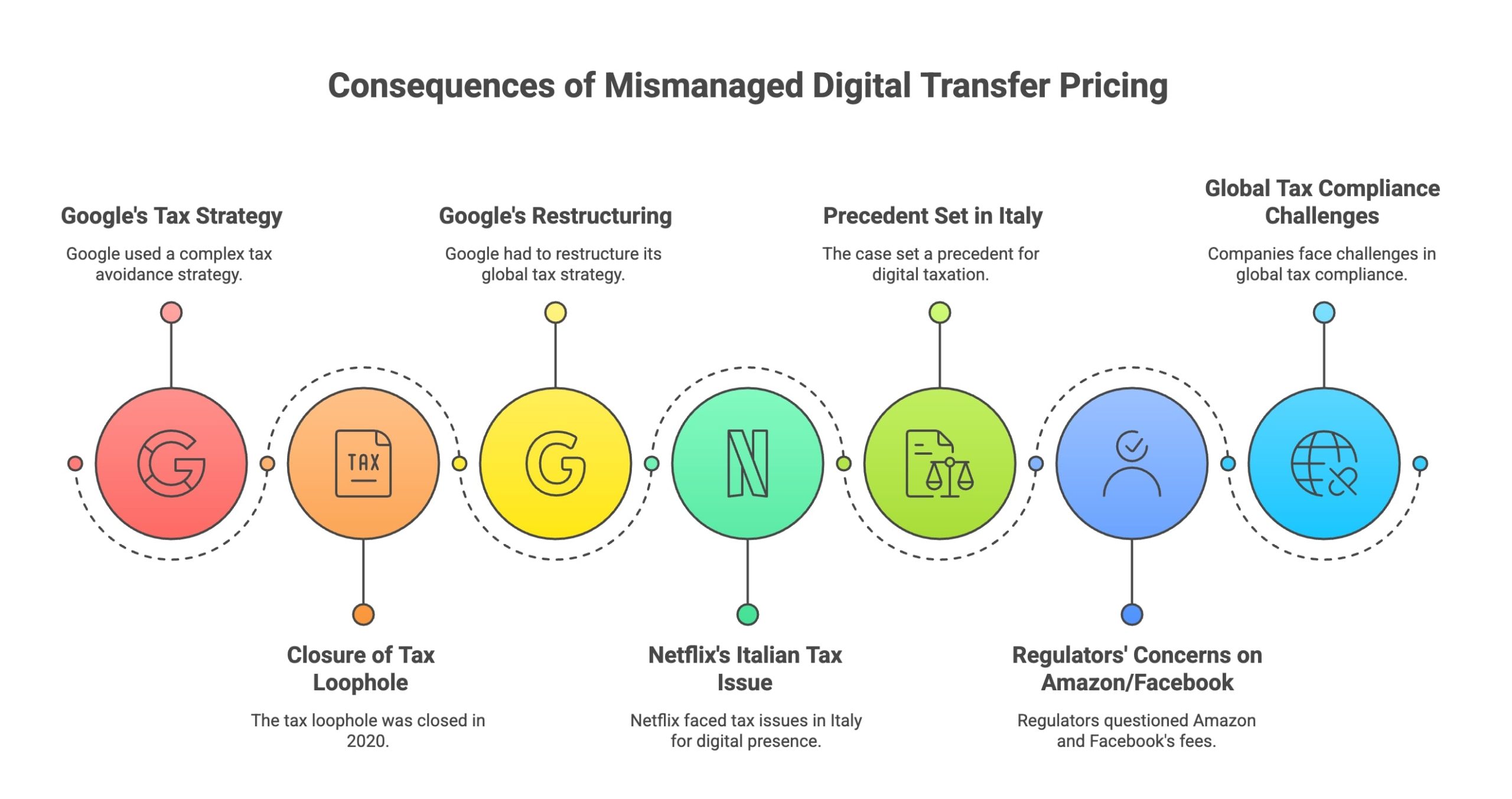 Take Google, which for years funneled billions through the “Double Irish, Dutch sandwich” strategy – a Byzantine tax loophole that allowed it to shift European profits to low-tax Ireland and then to Bermuda, where corporate taxes were zero. That loophole was closed in 2020, forcing Google and other tech giants to restructure their entire global tax strategies.Then there’s Netflix, which faced criticism in Italy for allegedly failing to properly report its profits. Italian authorities countered that Netflix didn’t have an office in the country, but its servers and streaming infrastructure counted as a “digital presence,” making it liable for Italian taxes. The case set an important precedent, showing that companies without offices or employees in a country can still be taxed.Meanwhile, regulators in India, Australia, and Spain have similarly raised concerns about Amazon and Facebook’s royalty and service fee arrangements, in which local subsidiaries pay billions to their parent companies for the “right” to use branding, technology, or support services. Now, tax authorities are questioning whether such fees reflect arm’s-length transactions or are simply a means of artificially shifting profits to tax-friendly jurisdictions.
The future of transfer pricing: what’s coming next?
The speed at which tax rules are changing is making traditional methods of transfer pricing outdated. With governments getting tougher on multinational companies, every transaction is being tracked by AI and real-time data sharing. 41% of global CEOs say adopting AI is key to improving business performance (EY, 2024). In other words, tax enforcement is getting smarter and business needs to move faster. Companies will need superior technology and agile strategies to deal with new tax rules.AI & automation: will technology make compliance easier?
AI is already helping businesses track their taxes, find errors, and stay compliant. It’s able to process massive amounts of data, detect errors long before audits, and keep companies up to date on tax laws. Tax authorities will also increasingly use AI to detect companies trying to avoid their taxes, making it harder to hide mistakes. The US IRS has launched an AI pilot aimed at monitoring tax gaps and increasing enforcement, the Government Accountability Office reported. Companies that embrace automation can reduce risk, save time, and focus on growing their business rather than dealing with tax issues.What to expect from new OECD guidelines & global tax changes?
The OECD is going to make the global tax rules even more rigid, especially in regard to digital businesses. The OECD Transfer Pricing Guidelines 2022 enhance transparency and strictness in financial reporting, while the initiative of Pillar One and Pillar Two does mean that:- Large companies will pay more tax in the countries where they generate profit.
- A minimum global tax of 15% will prevent companies from shifting profits to low-tax jurisdictions.
Why does your business need a future-proof transfer pricing strategy?
The waiting game for the tax laws to settle is no longer an option: businesses must be proactive. As tax authorities increasingly share data and use AI to enforce rules, the risk of getting caught for non-compliance is higher than ever. Those that don’t adjust may face unexpected tax bills and penalties:- Double taxation in several countries.
- Legal disputes that can drag on for years.
Why companies should collaborate with T1 Advisory to address transfer pricing strategy
T1 Advisory designs robust and future-proof transfer pricing strategies that ensure full compliance. Our experts are committed to intelligently structuring cross-border transactions and keeping companies compliant with OECD standards. We don’t just solve today’s challenges, we prepare your business for what comes next.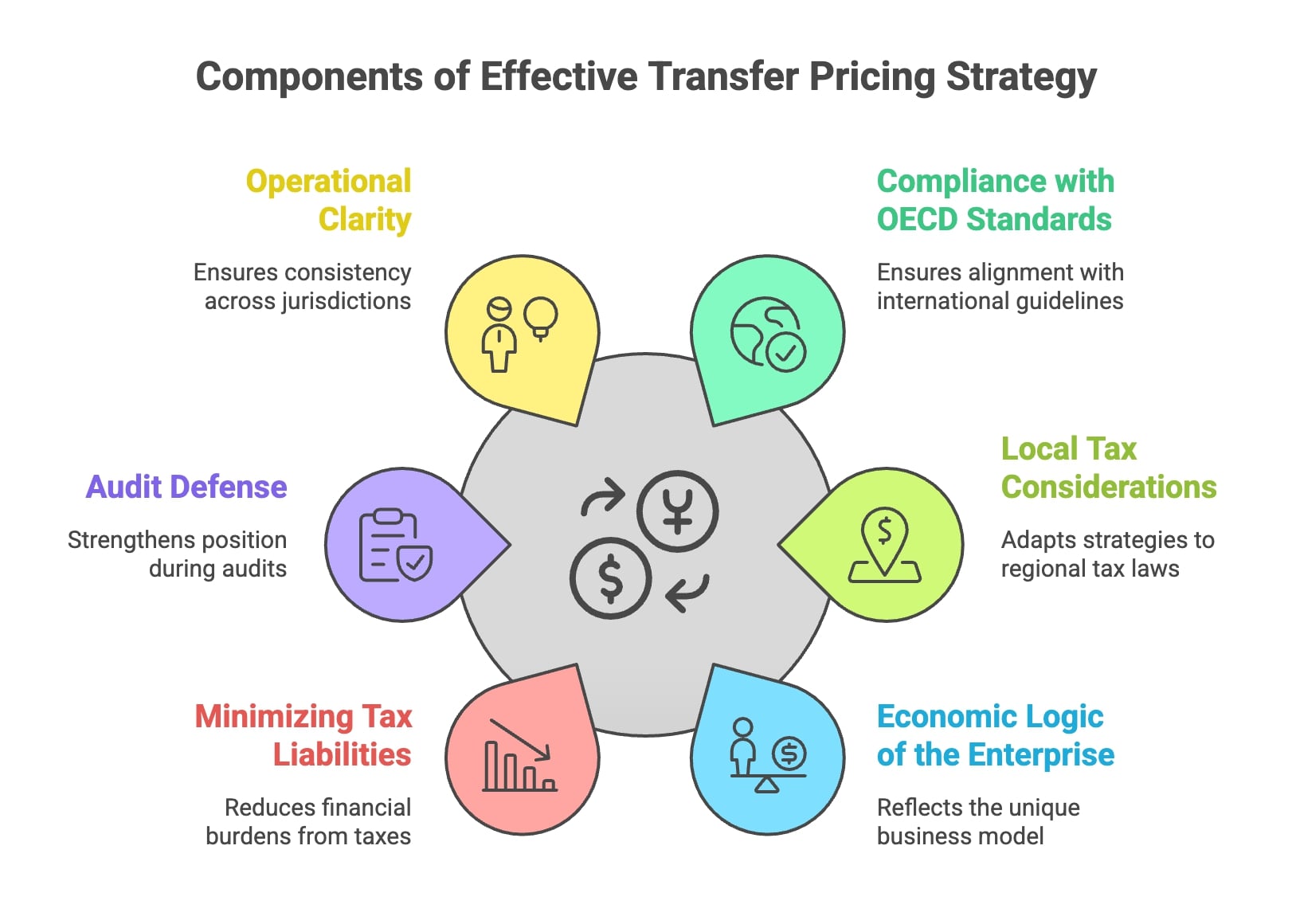
How T1 Advisory leads your business towards success in business operations
At T1 Advisory, we know well that transfer pricing is not all about compliance, but about integrity in business and financial stability. Every company has its unique ways, and those should be mirrored in the price-setting strategy. Instead of implementing some general patterns on our clients, we offer them individually created solutions that carefully consider the recommendations of the OECD, local tax authorities, and, of course, the economic logic of your enterprise.Our approach will ensure intercompany transactions are well-established, disputes are efficiently resolved, and compliance risks are at their minimum before they even have the potential to become burdensome. Being prepared for regulatory changes and creating transfer pricing strategies that work when tried and tested allows businesses to operate internationally with confidence, without ambiguity, inefficiencies, or increased tax exposures.Get it right for transfer pricing – increase compliance & reduce risks
A well-structured transfer pricing strategy is more than just a compliance requirement, it is actually one of the most effective cost-saving and risk-reducing tools for financial stability. Any failure tax to adapt one’s business to new tax regulation developments may result in double taxation, costly disputes, and major regulatory penalties. Here’s what a well-executed transfer pricing strategy can achieve:- Minimize tax liabilities with intercompany pricing that reflects both market conditions and regulatory expectations.
- Better audit defense with accurate and well-documented pricing models in front of the tax authorities.
- Operational clarity that prevents inconsistencies in transfer pricing policies across various jurisdictions.
