

When to Consider Interim Professionals: Key Triggers for Engaging Advisory Services
Business cycles rarely wait for perfect timing. An unexpected audit, market shift, or executive departure can force decisions overnight. Who steps in when a CFO resigns mid-audit or when a compliance deadline is weeks away? This is exactly the role of interim professionals: they bring targeted expertise and immediate leadership to stabilize operations, maintain compliance, and keep projects on track.Every company eventually faces the “unexpected” – a leadership gap, a compliance review, or a stalled transformation. Corporate timelines rarely align with market realities, and waiting for long hiring processes is not an option. Interim management services make it possible to engage interim professionals at the right moment, turning disruption into continuity and giving businesses the breathing space they need to stay in control. Key characteristics of interim professionals:


What are interim professionals in advisory services?
An interim professional is not theory but practice in motion. They arrive with a clear mandate: act fast, deliver results, and bridge gaps that cannot wait. Unlike consultants, they assume direct responsibility inside the company.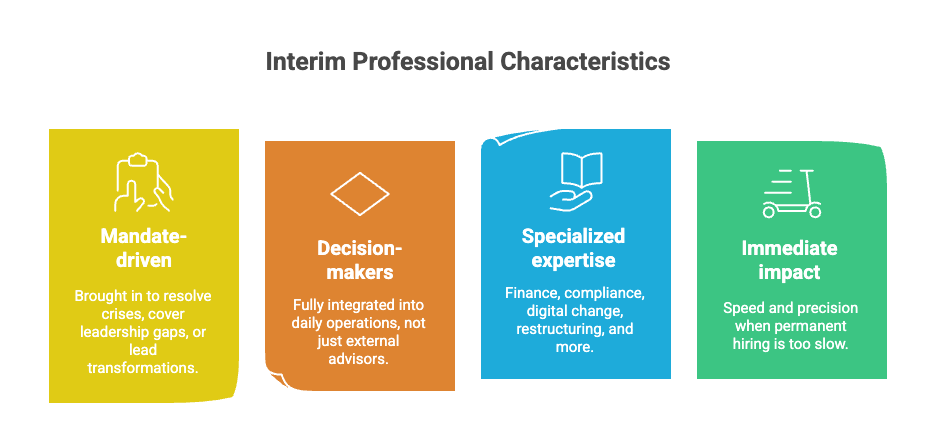 Key characteristics of interim professionals:
- Mandate-driven: brought in to resolve crises, cover leadership gaps, or lead transformations.
- Decision-makers: fully integrated into daily operations, not just external advisors.
- Specialized expertise: finance, compliance, tax, digital change, restructuring, and more.
- Immediate impact: speed and precision when the permanent hiring process is too slow.
When businesses should consider interim management support
Companies rarely plan for disruption, yet it is inevitable. A top executive’s resignation, an unexpected audit, or sudden regulatory change can leave a business exposed. In such cases, interim management provides continuity without the delays of a full recruitment cycle.Recent data shows that 78% of companies already use interim executives, up from 65% just two years ago. This demonstrates that interim leadership is no longer a niche solution but a mainstream response to urgent business challenges.Importantly, it is not only crises that justify interim advice. Companies also turn to interim leaders during planned transformations, mergers, IT system upgrades, or cross-border expansions. In these cases, the temporary nature of the role is a strength: the professional remains fully focused on delivery, without the long-term commitments of a permanent hire.Key triggers for engaging interim professionals
Companies don’t turn to interim professionals by accident. It happens when clear triggers arise: urgent deadlines, compliance risks, or transformation pressures that call for immediate interim management support.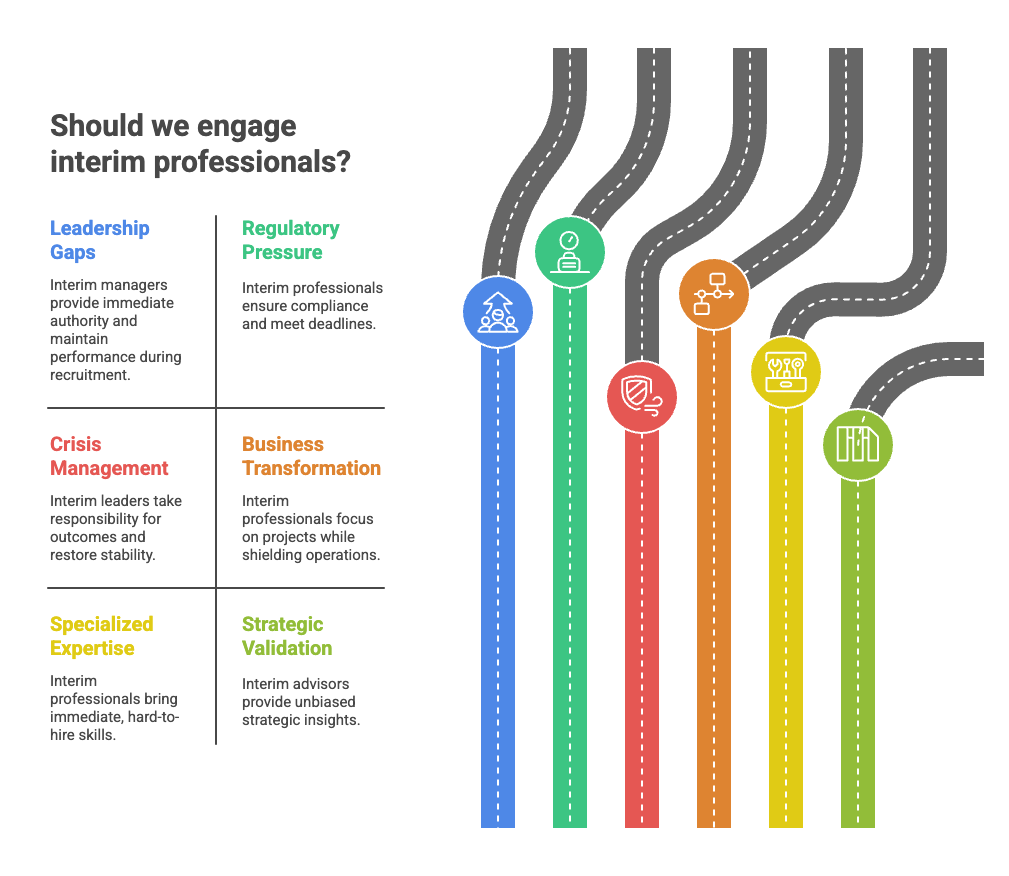
1. Leadership gaps that cannot wait
When senior leaders exit suddenly, momentum often stalls. Interim managers bring immediate authority, keeping performance on track while permanent recruitment takes place.2. Regulatory deadlines and compliance pressure
Tight audit schedules or sudden regulatory demands put businesses under pressure. An interim professional with compliance expertise ensures deadlines are met and risks are contained.3. Crisis situations that demand decisive leadership
Financial restructuring, litigation, or reputational issues demand more than external consulting. With interim management support, businesses gain leaders who take responsibility for outcomes, renegotiating debt, managing stakeholders, and restoring stability.4. Business transformations that need focus
Big changes test organizations at every level. Interim professionals provide focus and authority to carry projects through while shielding ongoing operations.5. Projects requiring specialized expertise
Some challenges require skills that aren’t easy to hire permanently – Environmental, Social and Governance (ESG) reporting, digital transformation, or cross-border tax rules, for example. Interim professionals bring this expertise immediately, without the delays of recruitment.6. Strategic decisions that need external validation
Leadership teams don’t always see blind spots. Interim advisory services provide independent professionals who can test assumptions, challenge strategies, and put plans into action with no internal bias.Across all these triggers, the real advantage of interim professionals lies in speed, accountability, and measurable impact. Unlike consultants, they are embedded in daily business operations, delivering solutions that align with compliance requirements, transformation goals, and long-term business strategy.How advisory services help bridge the leadership and skills gap
When a key employee leaves, the real challenge is not just the empty office – it is the vacuum of decision-making, direction, and accountability. Teams can function without a title for a while, but not without clarity. Advisory services step in here, connecting businesses with interim professionals who bring both authority and focus.The benefit is double. First, access to a vetted network of experts with proven records in finance, compliance, transformation, or sector-specific regulation. Second, structure: advisory firms don’t just introduce a professional, they frame the mandate, define outcomes, and monitor progress. The result is not a temporary patch but a bridge that keeps strategy intact while permanent leadership is secured.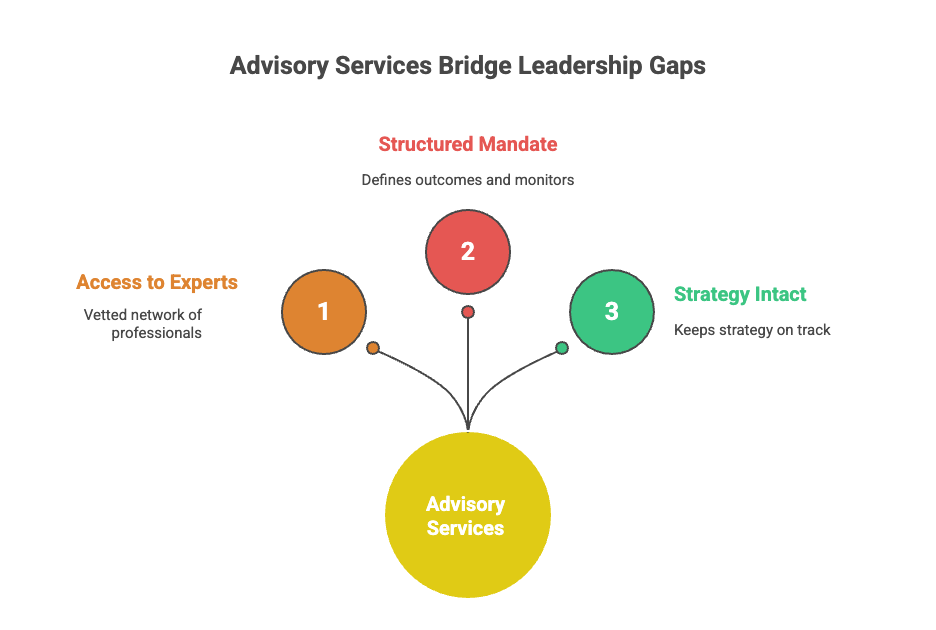
Interim professionals in times of crisis and transformation
Crisis is the true test for organization. Financial distress, litigation, sudden regulatory investigations, each demands not just advice but immediate execution. This is where interim management proves its worth. An interim CFO, for example, can renegotiate credit lines, restructure debt, and restore credibility with investors in weeks.Transformation projects are another proving ground. During mergers or IT systems rollouts, companies often underestimate the strain on internal teams. Interim professionals focus solely on delivery. They do not get distracted by office politics or long-term career paths, their mandate is execution. This clarity of purpose often means projects move faster, with fewer mistakes and measurable impact.Best practices for choosing interim advisory experts
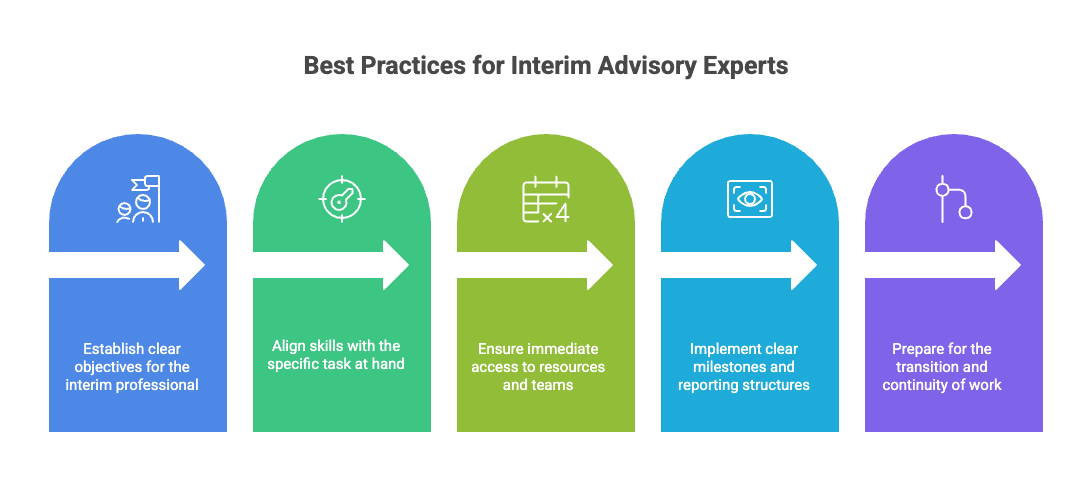
Engaging interim support is effective only when it is structured. Companies that achieve strong results with interim advisory services tend to follow these practices: