


When Business Becomes Extraordinary: Case Study of Germany
Extraordinary business transactions don’t fit into the usual operational rhythm, and under German tax law, that difference shows up quickly.
A restructuring, a movement of assets, an IP transfer – each of these transactions introduces questions that don’t arise in ordinary business activity. This article looks at how such a transaction plays out in real life, what companies tend to overlook, and why clear reasoning matters more than it seems at first.
Many companies rely on well-structured transfer pricing documentation to keep the process aligned and defensible, especially when the topic expands to include the valuation of a business transfer.
And here’s where it gets interesting: once you unpack the details of an extraordinary transaction, you start to see patterns – small decisions that make a big difference, subtle tax implications that only emerge later, and practical lessons that are easy to miss unless you’ve been through it before.
If you are located in Germany and planning a restructuring, the insights in this case study will help you see the broader picture and avoid a few common missteps along the way.
What makes a transaction extraordinary in Germany
Companies usually recognise extraordinary events only once they start disrupting the normal workflow. But from the perspective of German tax authorities, the threshold is crossed much earlier – at the moment a transaction changes the structure, function, or risk profile of a business.
In the latest version of Ordinance on the Type, Content and Scope of the Records as Referred to in Section 90 Subsection (3), Ordinance on the Documentation of Profit Allocations (GAufzV) of the German Fiscal Code (Abgabenordnung) dated 12 July 2017, German tax authorities establish the next transactions to be regarded as extraordinary business transactions:
- changes in long-term contracts that have a significant influence on the income that taxpayers receive from their business operations,
- asset transfers,
- the transfer of assets in connection with significant changes of functions and risks in companies,
- business transactions in connection with changes in business strategy that are relevant for transfer pricing purposes,
- the conclusion of contribution arrangements.
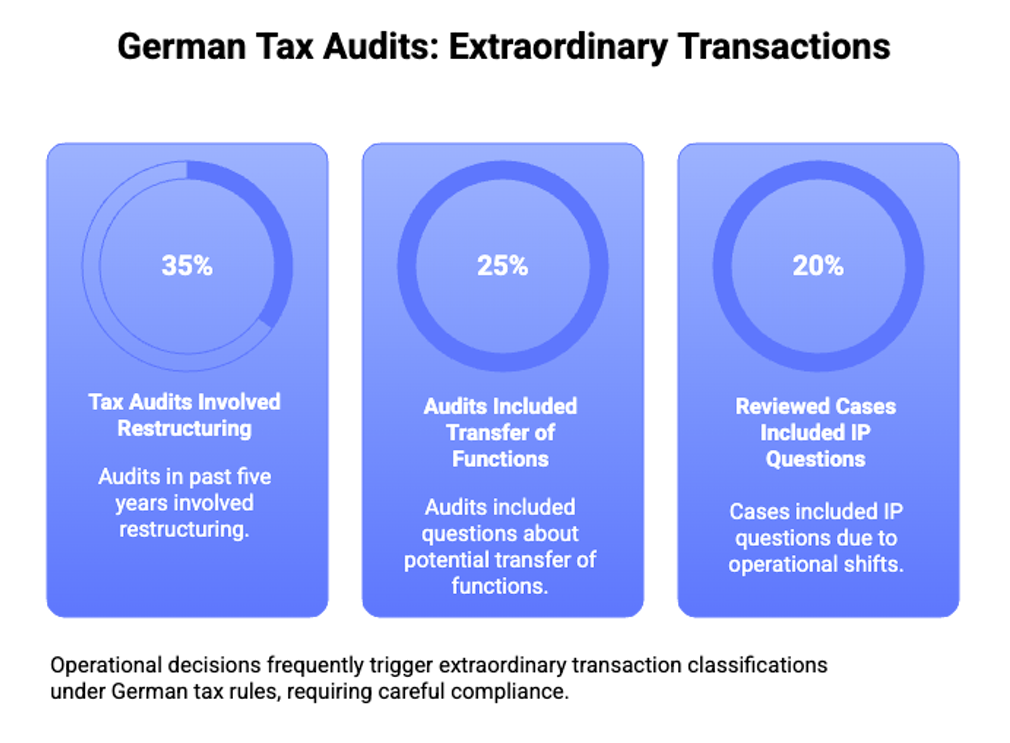
Some organisations underestimate how even a small operational shift can reshape the group’s economic footprint. Moving a development team from one subsidiary to another is a good example. When the shift affects who creates value, who bears risk, and who earns the return, the German tax authorities will expect clear reasoning.
This is the moment when “extraordinary” stops being a label and becomes a compliance obligation.
How German tax law distinguishes extraordinary vs. ordinary operations
German tax law draws a practical boundary: if an action can influence the distribution of value across entities, it is rarely considered routine.
Routine transactions repeat, follow a stable pattern, and do not change decision-making structures. Extraordinary events change something fundamental.
Several indicators help identify such cases:
- A substantial change in the assets or functions of an entity;
- A migration of people who drive strategic or development-related value;
- The reallocation of key risks or decision rights;
- A commercially significant shift in location or ownership of intangible assets.
- The conclusion of cost contribution/allocation agreements and implementation of a profit split structure.
The classification matters because the documentation, valuation, and audit expectations increase considerably once a transaction is considered extraordinary.
Typical situations: Restructurings, business transfers, IP moves, large asset deals
A few situations appear repeatedly in practice:
Business restructuring
Common across international groups, it often changes which entity performs strategic roles or owns operational functions. Even if the business restructuring is commercially necessary, authorities expect an explanation and clear economic reasoning.
Transfers of functions or assets
A production factory shutting down, a team relocating, or a key operational activity being migrated – all these reshape the economic footprint of a multinational group.
IP transfers and migrations
Moving intangible assets to another jurisdiction introduces complexity because value creation is difficult to measure. Even the migration of small IP components can create large questions in tax audits.
Sales of high-value assets or business units
These transactions require careful explanation of motive, valuation, and arm’s-length compensation.
Each scenario involves different risks, but the structure of the reasoning supporting them is similar.
The German tax law and legislation behind extraordinary business transactions
Understanding German tax law is not about memorising clauses. It is about anticipating how authorities evaluate intention, structure, and economic effect.
German tax rules strongly adhere to OECD arm’s length principle and focus on whether a transaction reflects what independent parties would do under comparable conditions. The presence of commercial purpose, economic substance, and coherent valuation logic is essential.
Authorities look at three things:
- Economic reasoning. Why this transaction is necessary and how it reflects the group’s strategy.
- Risk allocation. Who bears the risk and has the financial capacity to control it?
- Financial outcomes. Whether the resulting profits correspond to the fundamental functions and assets involved.
This framework aligns closely with OECD Guidelines, but Germany often applies it with more emphasis on documentation clarity and valuation consistency. German tax law follows high documentation standards, detailed scrutiny of valuation models, and low tolerance for inconsistencies between narrative, numbers, and written contracts.
For cross-border transactions, EU principles may also influence the analysis, especially in cases involving location advantages or migration of valuable activities.
The German case: Breaking down an extraordinary transaction
To see how these rules apply, consider a German company preparing to transfer a product development function to another EU entity.
- On paper, it is an efficiency exercise.
- In practice, it is a shift of profits and a moment when long-term operational and tax consequences must be carefully evaluated.
The scenario begins with declining utilization of the development team in Germany and a plan to centralise similar functions abroad. Management wants a unified structure, faster collaboration, and reduced overhead. Relocating the German team seems logical.
But the shift triggers questions immediately:
- Does moving the activity transfer value?
- Does it reduce the German entity’s earning potential?
- Are valuable intangibles embedded in the activity?
- Should compensation be paid for the relocation of functions?
- How should the transfer be valued?
These questions must be answered simultaneously, not sequentially.
The company then analyses the expected outcome. The German entity will relocate a DEMPE function, an activity that historically contributed to the creation of competitive features. The receiving entity will gain that potential. Whether this constitutes a transfer depends on the commercial ties between the activity and the company’s intangible assets.
The German company must show whether its expected returns remain reasonable after the change. If its expected returns decrease substantially, authorities will treat the restructuring as an extraordinary event that requires justification and potentially compensation.
Next comes the valuation challenge. Estimating the worth of transferred potential, including team expertise, historical development experience, and internal know-how, demands careful judgment. This may lead to a valuation of business transfers where qualitative elements influence the financial outcome. German tax authorities usually scrutinise the methodology, assumptions, and alignment between narrative and figures.
Finally, the documentation ties everything together. The company must clearly articulate motives, commercial logic, expected advantages, and how the transaction respects arm’s length principle. Without this coherence, even a reasonable restructuring becomes vulnerable to audit.
What businesses can learn
Three lessons stand out from such scenarios:
1. Documentation gaps create the most significant risk.
When a company explains the restructuring late or not entirely, authorities often challenge the sequence of decisions. Missing explanations are interpreted as a lack of logic.
2. Valuation issues emerge when qualitative elements are ignored.
Even when numbers look clean, overlooking know-how, workforce attributes, or the real economic contribution of a function weakens the valuation. The challenge is rarely mathematical – it is about capturing economic substance.
3. IP-related elements appear even when a company does not expect them.
Tax authorities may view development capability, ownership, or accumulated team knowledge as intangible components. If companies overlook this angle, they risk underreporting the value transferred.
These lessons apply broadly, not just to Germany. They reflect recurring patterns across extraordinary transactions.
How to reduce exposure and strengthen compliance during major transactions
A stable process begins well before the transaction is executed.
Companies benefit from involving tax, legal, operational, and finance teams early. Coordinating these views ensures that each step matches commercial reality. The earlier misalignments surface, the easier they are to correct.
Mitigating exposure includes:
- Clarifying economic motives at the start;
- Identifying which entity truly has the decision-making power;
- Documenting the expected future returns of each entity;
- Reviewing whether any intangible components are implicitly transferred;
- Ensuring valuation reports reflect realistic assumptions.
When these steps are taken seriously, extraordinary events become manageable rather than disruptive.
Guidance for companies planning extraordinary transactions
Before executing a major transaction, companies can review a few essential points that often determine how smoothly the process unfolds.
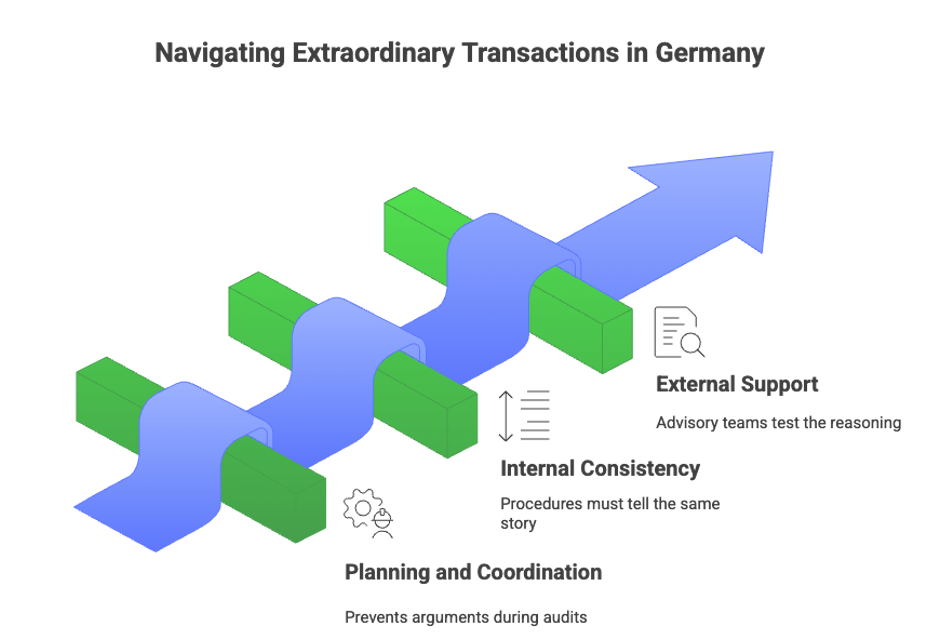
1. Planning and coordination
Cross-functional alignment helps prevent arguments that emerge later in audits. If commercial reality is apparent, tax reasoning becomes easier.
2. Internal consistency
Procedures, function descriptions, and strategic goals must tell the same story across departments.
3. External support
Advisory teams help test the reasoning, review valuations, and assess whether documentation is coherent and defensible.
A simple readiness list can guide the preparation:
- Are motives, expected benefits, and economic shifts explained clearly?
- Is it obvious which functions, assets, and risks are transferred, and why?
- Does the transaction change earning potential?
- Are the valuation assumptions supportable?
- Does the documentation align with actual operational behaviour?
When companies answer these questions early, execution becomes far smoother.
Why extraordinary decisions demand extraordinary preparation
Extraordinary transactions are not inherently risky. They become risky when their commercial logic is unclear, when valuation assumptions cannot be defended, or when documentation fails to reflect how the business truly operates.
German tax law focuses heavily on coherence – between narrative and numbers, between motives and outcomes, between decision-making and profit allocation. When companies maintain that coherence, even complex restructurings become straightforward.
This German case study highlights a simple message – extraordinary events require more than technical compliance. They require reasoning that is transparent, consistent, and commercially credible.
With that foundation, organisations can navigate restructurings, IP transfers, and major asset movements with confidence, while keeping audits predictable and controllable.
Key questions about extraordinary transactions in Germany
1. What qualifies as an extraordinary business transaction?
These are events that fall outside normal operations, such as restructurings, transfers of functions, asset shifts, or IP relocations. Each triggers specific tax reviews because they may change where value is created within the group.
2. How does a business restructuring trigger tax consequences?
Authorities examine whether functions, assets, or risks move between entities. If value is transferred, compensation may be required, and the restructuring can create taxable events even without external transactions.
3. How are IP transfers reviewed during tax audits?
Tax auditors analyse who performs the DEMPE activities and whether compensation reflects each entity’s economic role. Misaligned substance or unclear valuation often leads to challenges.
4. What documentation is required for extraordinary business transactions?
Companies must provide a clear explanation of motives, structure, economic effects, and valuation logic. Documentation must connect narrative reasoning with financial outcomes to remain defensible.
5. Which valuation methods are accepted in Germany for extraordinary business transfers?
German practice typically favors income-based valuation approaches (e.g., discounted cash-flow method, earnings value method) supported by robust assumptions and sensitivity checks. Tax authorities expect transparency around cash flows, risks, and allocation of synergies.
6. What risks arise when valuation and documentation are not aligned?
Gaps between economic reasoning and numbers immediately raise audit concerns. Misalignment can result in adjustments, penalties, or disputes over whether compensation reflects the arm’s length principle.
7. How should companies prepare for a tax audit focused on restructuring or IP transfers?
Preparation includes validating assumptions, ensuring documentation matches actual business behavior, and mapping the decision trail. Early alignment among finance, tax, and legal functions significantly reduces risk exposure.
