


Risk Management and Dispute Resolution in Transfer Pricing: From Tension to Strategy
What’s your biggest tax audit nightmare?
For many multinational enterprises, it’s the sudden knock of a transfer-pricing inquiry – one that drags on for years, draining resources, consuming leadership attention, and clouding reputations.
These aren’t just disputes over line items, they’re signals of something deeper: mismatches between value creation and value reporting. When costs collide across borders, price mismatches can set off alarms from Berlin to Bangalore, drawing scrutiny from tax authorities triggering them to challenge outcomes that don’t seem to align with economic reality.
But what if this tension could be transformed into a source of strategic strength?
Leading companies are shifting from reactive defense to proactive design. They’re embedding early-warning systems, real-time analytics, and robust dispute-resolution playbooks into their transfer-pricing operations. They’re not just preparing for audits, they’re planning for strategic certainty. From policy design to successful negotiation, it’s no longer about surviving scrutiny but mastering it.
At T1 Advisory, we help companies reframe transfer pricing from a vulnerability into a strategic asset. Whether it’s implementing effective risk controls, resolving disputes across jurisdictions, or aligning your pricing models with substance, we support clients in building resilience where others see risk.
Why transfer pricing feels like walking a tightrope
Imagine you’re an acrobat suspended between two skyscrapers. Below, one misstep means a costly audit. Above, the wind of evolving OECD guidance blows unpredictably.
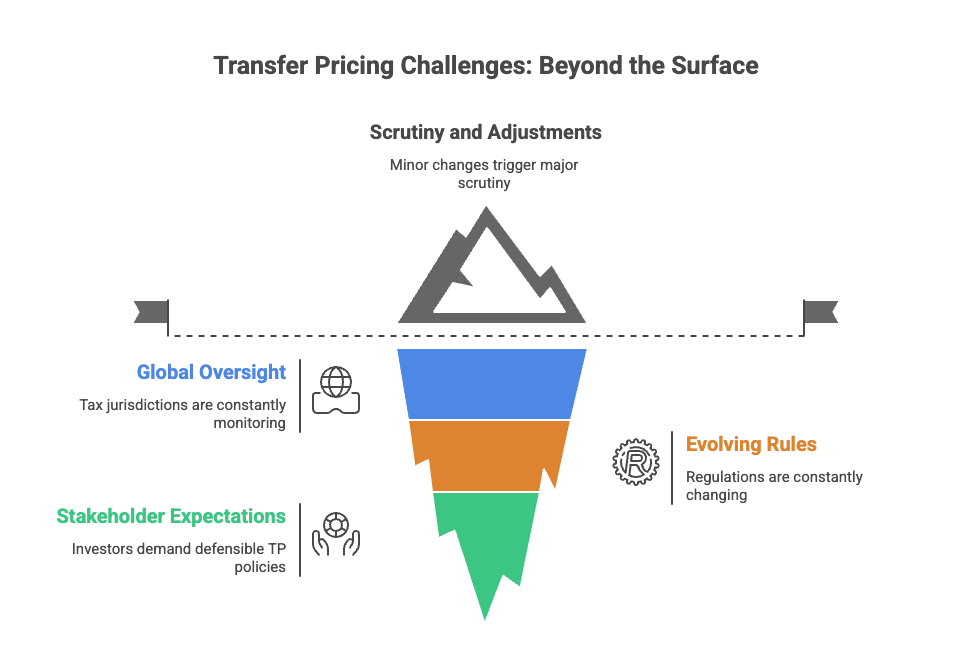
That’s the world of transfer pricing, balancing intercompany margins so thin that a slight shift in comparables or a change in benchmarking can send you into controversy.
- Global scrutiny is relentless. Automatic exchange networks and real-time data analytics mean every jurisdiction is watching.
- The rules keep evolving. From BEPS Action 13 tweaks to digital economy debates, today’s safe harbor can become tomorrow’s red flag.
- Stakeholder expectations are rising. Investors, boards, and environmental, social and governance (ESG) frameworks now view transparent, defensible transfer-pricing policies as a measure of corporate governance.
- Global scrutiny is relentless. Automatic exchange networks and real-time data analytics mean every jurisdiction is watching.
Against this backdrop, complacency is the greatest risk. You need more than robust documentation, you need an integrated risk-management strategy that lets you perform with confidence.
Anatomy of transfer pricing risk: Beyond the obvious
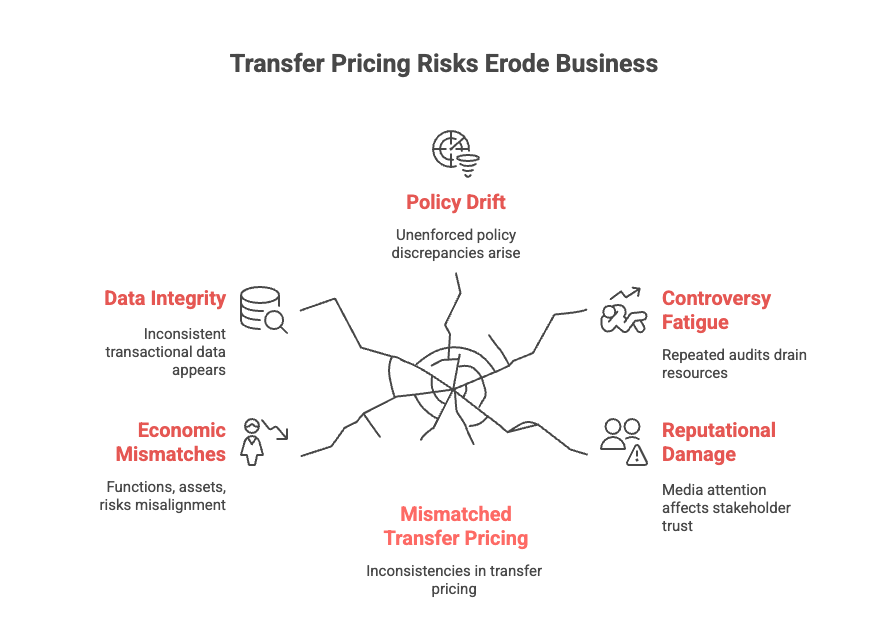
Transfer-pricing disputes often appear as debates over discount rates or comparability adjustments. Yet the true risks lie deeper:
- Economic substance mismatches. When functions, assets, and risks don’t align with where profits are booked, authorities will question your business model itself.
- Data integrity gaps. Inconsistent or missing transactional data, from ERP mismatches to outdated local ledgers, fuels auditor skepticism.
- Policy–practice drift. A policy written on Day 1 that isn’t enforced on Day 365 becomes a trap. Discrepancies between your documented method and actual intercompany invoices are gold mines for challengers.
- Controversy fatigue. Repeated audits in multiple jurisdictions create “audit fatigue,” draining resources and weakening negotiating positions.
- Reputational spillovers. High-profile transfer-pricing challenges can spark media attention, affecting credit ratings and stakeholder trust even before adjustments are finalized.
Understanding these layers is crucial: only by diagnosing the full risk profile can you tailor defenses that go beyond footnotes and folder structures.
Designing a transfer pricing risk radar
Turning tension into strategy starts with visibility. A Risk Radar helps you detect emerging issues early and triggers the right actions:
- Benchmark volatility monitor. Track shifts in comparable-company data and margin trends quarterly, not just annually, to flag when your pricing falls outside defensible ranges.
- Jurisdiction heat map. Map active audits, open inquiries, and notable rulings by tax authority. Color-code risk levels to prioritize where you need resources and expert support.
- Policy–execution dashboard. Integrate data feeds from your enterprise resource planning (ERP), tax-reporting systems, and legal log to compare documented policies against actual transactional flows.
- Alert protocols & escalation paths. Define clear triggers (e.g., >5% margin variance, unexpected related-party revenue spikes) and assign cross-functional response teams, tax, finance, legal, and operations.
- Conflict simulation workshops. Run tabletop exercises simulating audit challenges to test your documentation, negotiation scripts, and settlement templates.
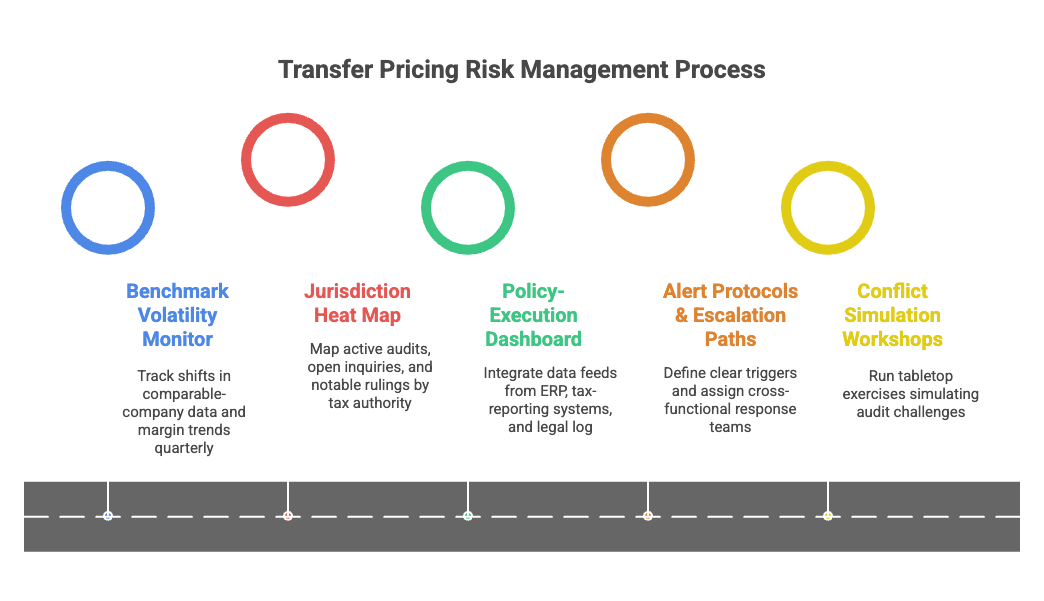
With these elements in place, you’ll see potential flashpoints long before they spark, and have the playbooks ready to defuse them.
Soft shields: How to reduce risk before it starts
Prevention is always better than cure. These “Soft Shields” help you shore up defenses before a single audit letter lands on your desk:
- Governance & culture. Embed transfer-pricing accountability into your board-level risk framework. Include C-suite visibility, periodic training, and reward structures for compliance excellence.
- Process discipline. Standardize intercompany invoicing, credit-approval workflows, and month-end reconciliations to eliminate ad-hoc pricing decisions that erode defensibility.
- Advanced analytics. Leverage machine-learning tools to spot outliers in intercompany transactions, whether it’s unusual volumes, atypical payment terms, or unexpected cost allocations.
- Documentation cadence. Move from a “once-a-year” documentation sprint to a rolling file approach: update key benchmarks, comparables, and policy rationales quarterly.
- Cross-border collaboration. Establish pre-audit communication channels with major tax authorities, share draft methodologies and invite feedback. Early alignment can cut months (or years) off potential disputes.
By weaving these strategic and operational elements together, you transform transfer-pricing from a high-wire act into a well-choreographed performance.
At T1 Advisory, we partner with MNEs to design, deploy, and defend holistic transfer-pricing frameworks, so you’re not just reacting to tension, but proactively shaping your risk-management and dispute-resolution journey.
APAs as risk vaccines: Early agreements, long peace
What if you could safeguard your company against future transfer-pricing disputes, years in advance? That’s the promise of an Advance Pricing Agreement (APA). These are not just tax rulings; they’re bilateral or multilateral risk vaccines.
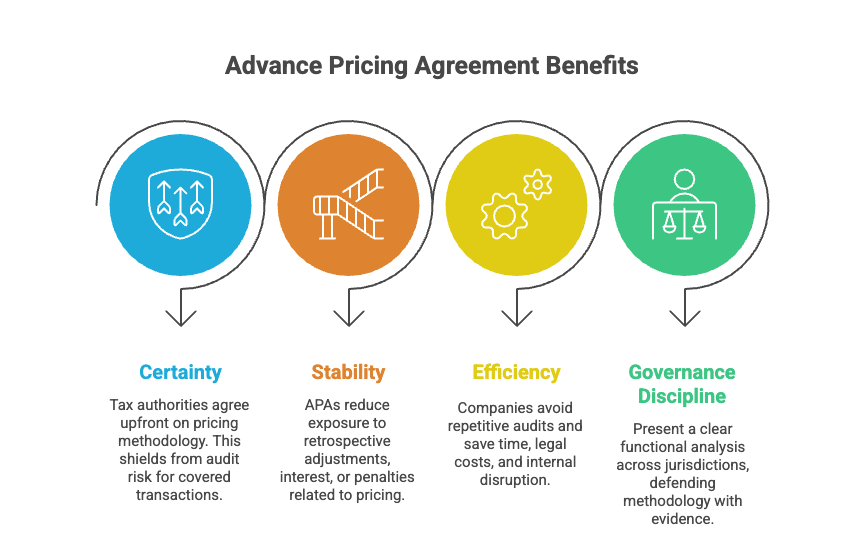
APAs are formal agreements between a taxpayer and one or more tax authorities that predefine how intercompany transactions will be priced over a set period (typically 3–5 years, with possible extensions). If structured and negotiated well, they offer:
- Certainty. Tax authorities agree upfront that your pricing methodology is acceptable, shielding you from audit risk for the covered transactions.
- Stability. APAs reduce exposure to retrospective adjustments, interest, or penalties.
- Efficiency. Companies avoid repetitive audits and save time, legal costs, and internal disruption.
But the real value lies in how APAs embed governance discipline:
- You must present a clear, consistent functional analysis across jurisdictions.
- You must defend your methodology with evidence – robust comparables, financial projections, and sensitivity testing.
- You must commit to a monitoring framework to ensure compliance throughout the APA term.
We often advise clients to explore bilateral or multilateral APAs, not just unilateral ones, as they provide alignment between home and host countries, dramatically reducing the risk of double taxation. For businesses in highly scrutinized sectors (tech, pharmaceuticals, extractives), APAs can be the single most cost-effective long-term defense strategy.
The inevitable: When a dispute happens
Despite the best controls and compliance, disputes can, and do, happen. The key is to stop reacting emotionally and start managing the process wisely.
Transfer-pricing controversies often begin with an inoffensive query:
“Please provide additional documentation regarding your related-party transactions.”
What follows can range from a short clarification to a long-lasting audit involving formal assessments, counter-positions, and appeals.
The lifecycle of a TP dispute:
- Initial notice or inquiry. Often informal, but signals the start of a review. Early missteps here (e.g., inconsistent responses or delays) can escalate risk.
- Audit or examination phase. The authority drills into functional analysis, comparables, and financial alignment. Any disconnect between policy and practice becomes exposed.
- Adjustment & position paper. If the authority disagrees with your method, they propose a revised calculation, sometimes with significant retroactive tax exposure.
- Negotiation or appeals process. Companies may request reviews, initiate domestic legal appeals, or trigger Mutual Agreement Procedures (MAPs) to avoid double taxation.
- Resolution, or litigation. Outcomes vary: negotiated settlements, forced adjustments, or full-blown court disputes.
We help clients avoid emotional or reactive responses at any point in this chain. A calm, data-driven, narrative-backed approach almost always delivers better outcomes, especially when you treat tax authorities as counterparties, not adversaries.
Audit survival kit: How to speak TP to tax authorities
Audits are as much about communication as they are about compliance. Tax authorities want clarity, consistency, and cooperation.
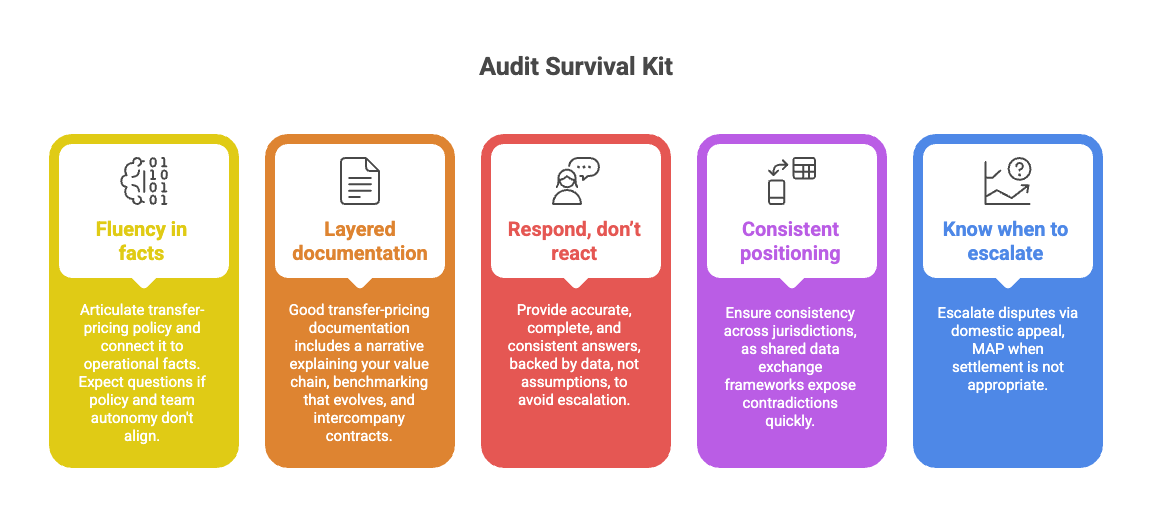
Here’s your audit survival kit:
1. Fluency in facts
You must be able to articulate your transfer-pricing policy clearly and connect it to real operational facts. If the policy designates your entity as a limited-risk distributor, yet the local team exercises pricing autonomy, this discrepancy will likely attract scrutiny and may result in adjustments.
2. Layered documentation
Good transfer-pricing documentation isn’t just a Master File and Local File. It’s:
- A narrative that explains your value chain.
- Benchmarking that evolves over time, not reused blindly.
- Intercompany contracts that reflect actual business activity.
3. Respond, don’t react
Authorities often test your reaction to pressure. Don’t give them a reason to escalate. Provide accurate, complete, and consistent answers, backed by data, not assumptions.
4. Consistent positioning across jurisdictions
What you report in Mexico must match what you report in Germany. Shared data exchange frameworks like the OECD’s Common Transmission System (CTS) mean contradictions are exposed fast.
5. Know when to escalate
Not every dispute is meant to be resolved outright. Certain matters warrant escalation through domestic appeal, APA, or MAP channels. The key lies in discerning when to stand firm and when to seek compromise.
Global playbook: Managing TP risk across jurisdictions
Transfer pricing is not merely a local matter; it is inherently global. Its complexity arises from the fact that each jurisdiction operates under its own distinct rules, priorities, and cultural approaches to audits and enforcement.
Here’s how to manage risk across borders:
1. Segment your risk by region
Not every country poses equal audit exposure. Build heat maps that consider:
- Audit aggressiveness (e.g., India, Brazil, France),
- Documentation enforcement levels (e.g., Germany, Japan),
- Double-taxation relief strength (e.g., MAP effectiveness in Netherlands vs. China).
2. Localize within a global framework
Your global TP policy must be anchored centrally, but translated locally. Local Files must reflect:
- Jurisdiction-specific financial metrics,
- Language and currency requirements,
- Domestic comparables, when needed.
3. Invest in relationship management
In many countries, especially in Latin America and Asia, how you engage with the local tax authority matters as much as what you file. Pre-filing discussions, regular updates, and mutual respect can avoid costly disputes.
4. Stay ahead of emerging risk zones
With global shifts toward public Country-by-Country Reporting (CbCR), digital services taxes, and Pillar Two implementation, risk is moving fast. Jurisdictions that were historically quiet are becoming vocal, and better coordinated.
5. Unify internal stakeholders
Effective global TP governance requires alignment across:
- Finance (for data accuracy),
- Legal (for contract enforcement),
- Tax (for strategy),
- Business units (for functional truth).
T1 Advisory, supports clients by building centralized TP control towers with strong local interfaces, ensuring your global pricing logic holds up under regional scrutiny.
Digital risk in transfer pricing: Welcome to algorithmic audits
The tax auditor of the future may not wear a suit, it may run on Python.In many jurisdictions, especially within the EU, Asia, and Latin America, tax authorities are embracing data-driven enforcement.
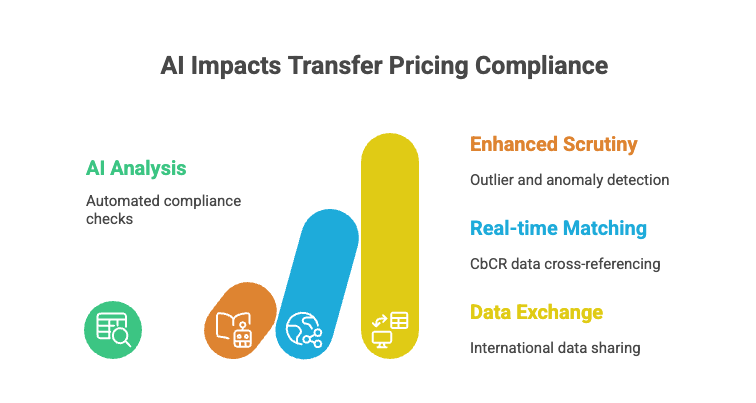
Traditional audits triggered by red flags or whistleblower tips are being replaced, or supplemented, by algorithmic risk scoring, AI-powered anomaly detection, and pattern-matching based on multilateral data flows.
What does this mean for transfer pricing?
Machine vs. human judgement
Algorithms don’t sleep, and they don’t miss outliers. They compare your reported margins, intercompany flows, and functional roles not just to your own prior filings, but against industry peers, regional norms, and treaty databases.
Automated benchmark scrutiny
Authorities are increasingly applying AI to detect:
- Use of outdated or cherry-picked comparables,
- Sudden year-on-year margin shifts,
- Anomalies in profit/labor ratios across jurisdictions.
Real-time CbCR cross-matching
Your CbCR isn’t isolated anymore. It’s fed into national risk engines that flag mismatches between tax paid and value created, sometimes before an actual return is filed.
Digital peering via data exchanges
Under frameworks like the OECD Common Transmission System (CTS), over 100 countries are now sharing XML-based CbCR files in machine-readable formats. If one jurisdiction detects an inconsistency, others see it too.
Strategic outlook: TP risk as a strategic function
If tax risk once lived in a back office, today it’s firmly on the boardroom agenda. Transfer pricing is no longer a technical accounting matter, it’s a strategic function that links business structure, commercial reality, and reputational exposure.
Here’s what that shift looks like:
1. From reporting to operational design
Strategic TP isn’t just about what margin to defend, it’s about how to structure your business in a way that the margins make sense. That means:
- Aligning supply chain flows with risk allocations.
- Locating IP in jurisdictions with real substance and defensible benefits.
- Embedding tax logic into product pricing and commercial terms, not just reporting documents.
2. Risk ownership moves upward
Leading companies are now placing tax risk matrices in their enterprise risk dashboards, reviewed quarterly at board or audit committee level. Why?
Because transfer pricing can:
- Drive disputes that affect financial reserves and shareholder equity.
- Trigger media coverage that affects ESG scores.
- Influence deal structures in M&A and cross-border investments.
3. Tax + ESG = strategic synergy
As sustainability and transparency rise on the investor agenda, tax behavior is now viewed as a proxy for corporate integrity. Public CbCR, ethical tax principles, and responsible value chain planning all intersect with transfer pricing.
Strategic TP teams now work with legal, treasury, compliance, and ESG, not in silos.
T1 Advisory’s roadmap: Aligning transfer pricing with corporate purpose
Transfer pricing is often seen as a technical topic, buried in spreadsheets, footnotes, and arm’s-length formulas. But in today’s global economy, it’s much more than that. It’s about where companies create value, and whether that value is aligned with their obligations to the societies in which they operate.
It’s about navigating fragmented legal systems, real-time enforcement, and algorithmic scrutiny, while staying true to your business model and strategic intent. It’s about building trust, with tax authorities, regulators, investors, and the public.
At T1 Advisory, we don’t treat transfer pricing as a compliance cost. We treat it as a strategic asset – one that, if managed wisely, protects reputation, secures operational continuity, and positions your company as a leader in responsible cross-border enterprise. Let’s make your transfer-pricing story one worth telling.
Reach out to the T1 Advisory team to start building your global TP risk framework – or to review your current model before the next challenge comes knocking.
