


Determining an Arm’s Length Range: German Experience
Germany did not invent the arm’s length principle, but it shaped the way Europe applies it.
Over decades, German tax authorities and courts have developed detailed guidance on how to construct, narrow, and defend an arm’s length range. This experience highlights the interplay between OECD standards and domestic practice, offering lessons well beyond national borders and setting a benchmark for effective transfer pricing governance.
Defining a fair market range is simple in theory, but rarely simple in practice. When a multinational entity (MNE) sits across the table from the German tax authorities, the central question remains: where does the arm’s length range begin, and where does it end? Germany has developed one of the most structured answers in Europe – one that blends statistical rigor with legal and economic context.
At T1 Advisory, we analyze this approach to help businesses navigate complex transfer pricing landscapes with the same clarity and defensibility that characterize German practice.
What is the arm’s length principle, and why it matters in transfer pricing
A transaction between related parties should resemble a deal between independent businesses. That is the essence of the arm’s length principle.
It ensures that intra-group transactions, whether for goods, services, financing, or intangibles, are priced as if the companies were unrelated.
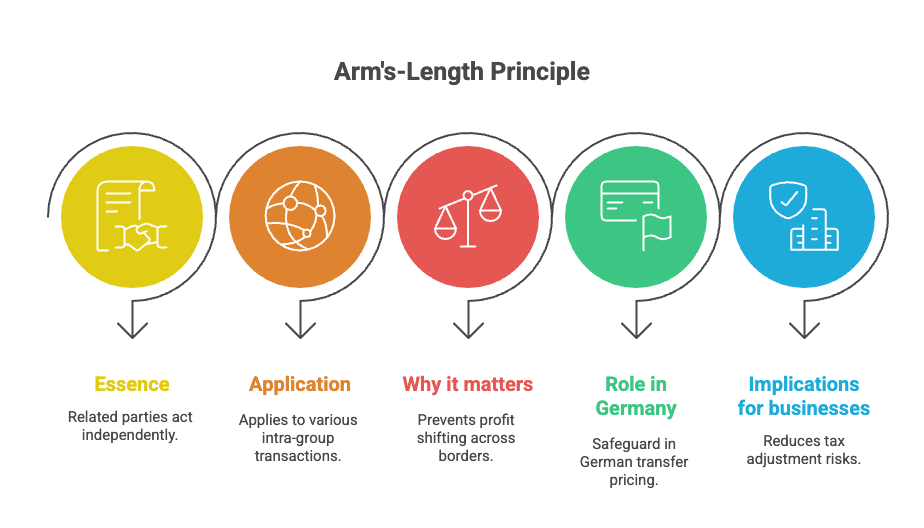
Why does this matter? Because without the arm’s length principle, multinational groups could shift profits across borders in ways that distort where value is created.
For tax authorities worldwide, and especially in Germany, it is the central safeguard that keeps transfer pricing aligned with market reality.
For businesses, adhering to this principle is not only about preventing adjustments. It is about demonstrating transparency and reducing risks in transfer pricing compliance.
German transfer pricing framework: from OECD to Finanzamt practice
Germany implements the OECD Transfer Pricing Guidelines, supplementing them with detailed national rules, court practice, and administrative guidance.
The Finanzamt requires taxpayers to maintain contemporaneous documentation and to justify transfer pricing positions in depth. Audits are common, and penalties for inadequate documentation can reach up to EUR 1,000,000, plus surcharges for non-compliance.
German law (§§ 1 AStG, AO) obliges companies to demonstrate that cross-border related-party transactions follow the arm’s length principle. The taxpayer bears the burden of proof. If documentation is incomplete or unconvincing, the Finanzamt is entitled to adjust taxable income using its own estimates.
| Aspect | OECD guidelines | German transfer pricing (Finanzamt) |
| Legal basis | Soft law, non-binding | Binding under German law (AStG, AO, BMF circulars) |
| Documentation | Master File & Local File | Master File, Local File, CbCR, contemporaneous documentation (due within 30 days of request) |
| Ranges | Interquartile range recommended | Interquartile range generally required; median often applied if results fall outside |
| Burden of proof | Shared | Fully on the taxpayer; lack of proof leads to income adjustments |
| Courts’ role | Interpretative reference | Extensive jurisprudence defining comparability, DEMPE, and adjustments |
German case law has clarified, for instance, that secret comparables (data available only to the tax authority) can be used, and that economic substance outweighs contractual form.
Courts have also confirmed that the median of the interquartile range may be applied if a taxpayer’s results fall outside the range.
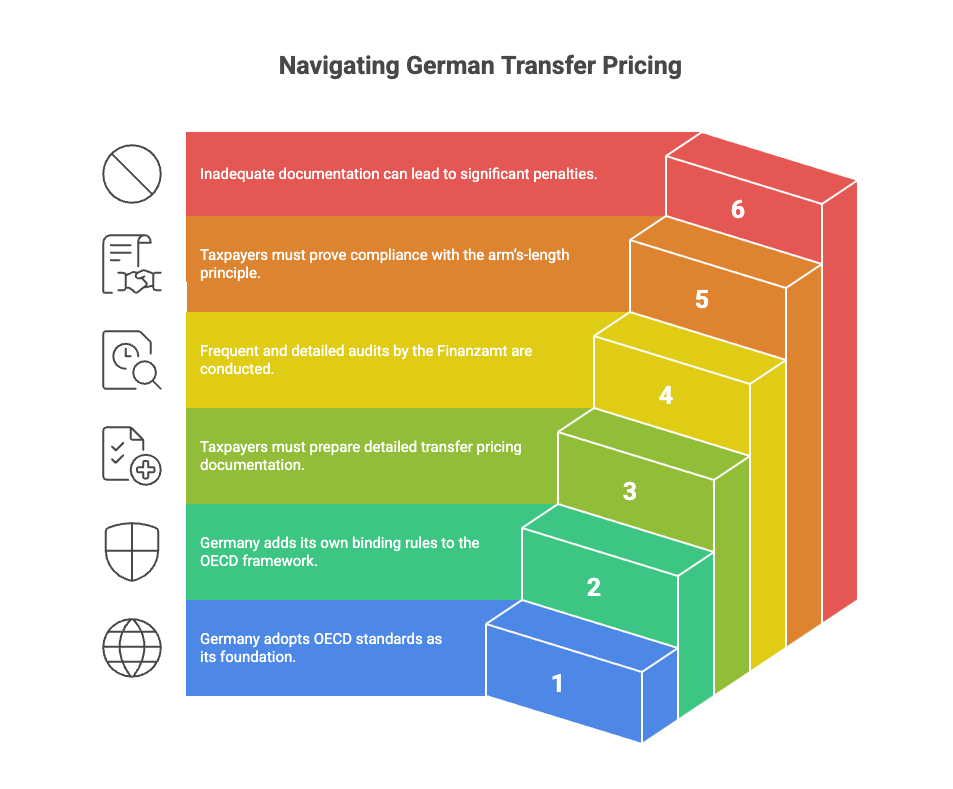
The result is a system where transfer pricing compliance is not optional but a constant, ongoing requirement. For companies operating in Germany, this means rigorous preparation of transfer pricing documentation, constant updates according to business processes, careful functional and comparability analyses, and readiness for detailed audits.
Building the range: methodology, data, and legal nuance
In Germany, an arm’s length range must be based on reliable comparables and a clear functional analysis of assets, risks, and functions. The German tax authority (Finanzamt) expects taxpayers to show why the chosen set of comparables is appropriate.
The interquartile range is the standard tool: it removes outliers and delivers a defensible benchmark. If a company’s result falls outside, the median may be applied for adjustments.
Numbers alone are not enough. German practice gives weight to contracts, industry specifics, and economic substance, which often determine where within the range results are accepted.
Practical challenges in determining an arm’s length range in Germany
How far can data really take you? That’s the constant dilemma for companies under German transfer pricing scrutiny.
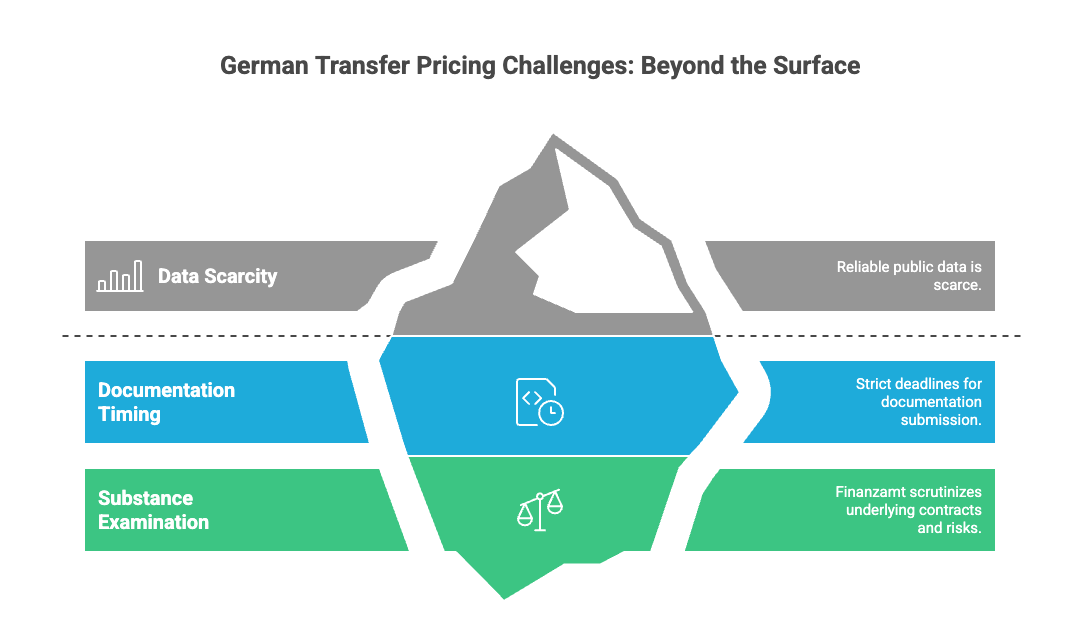
The Finanzamt demands robust comparables, yet reliable public data is often scarce, especially for highly specialized industries or unique intangibles. As a result, taxpayers struggle not only to find external benchmarks but also to defend why those benchmarks should be considered “comparable.”
Another challenge is timing. German rules require contemporaneous documentation; taxpayers must be able to provide complete files within 30 days upon request. Failure materializes penalties and unfavorable adjustments.
Finally, there is the issue of substance. Even when numbers fall neatly inside an interquartile range, the Finanzamt examines whether the underlying contracts, functions, and risks actually justify that outcome. For businesses, this means transfer pricing compliance is never just about figures; it is about proving the economic reasoning behind them.
How courts and audits shape the boundaries of acceptable ranges
German courts have clarified that if results fall outside the interquartile range, the median can be imposed, and even secret comparables may be used if they offer a more reliable benchmark. The Finanzamt relies on this jurisprudence during audits, which are detailed, often lengthy, and focused on functional analysis and intercompany contracts. Adjustments are frequent, especially in cases involving intangibles or financing.
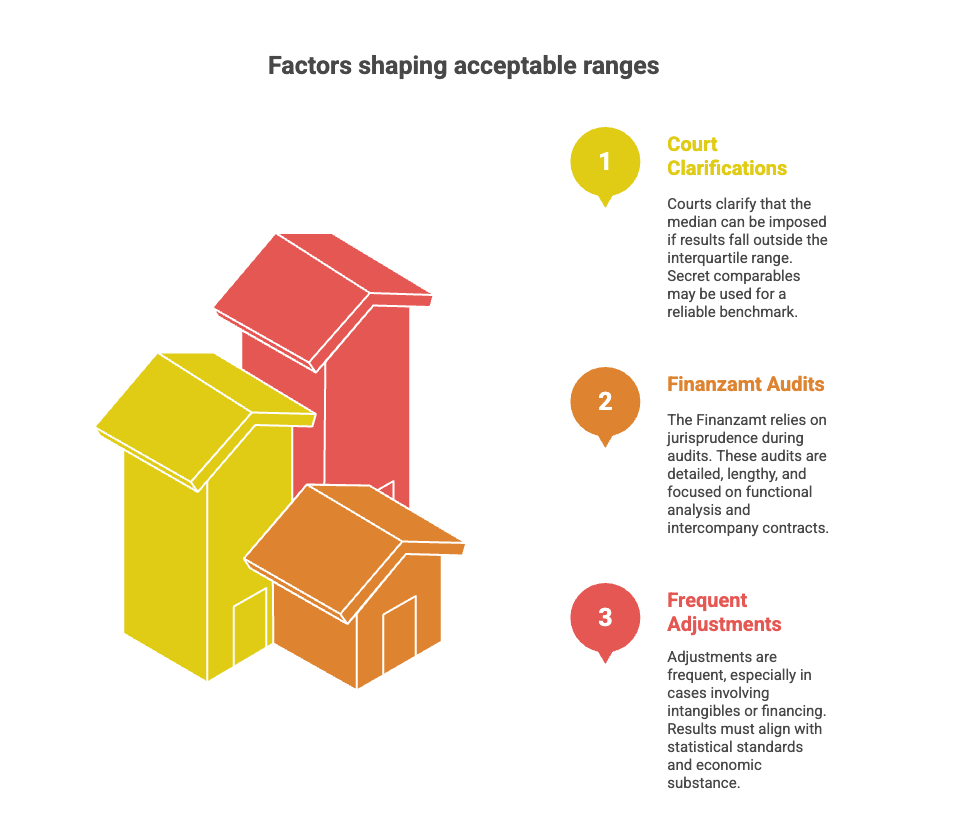
The clear message: in Germany, acceptable results must align with both statistical standards and economic substance, supported by solid documentation.
Best practices for multinationals: insights from German experience
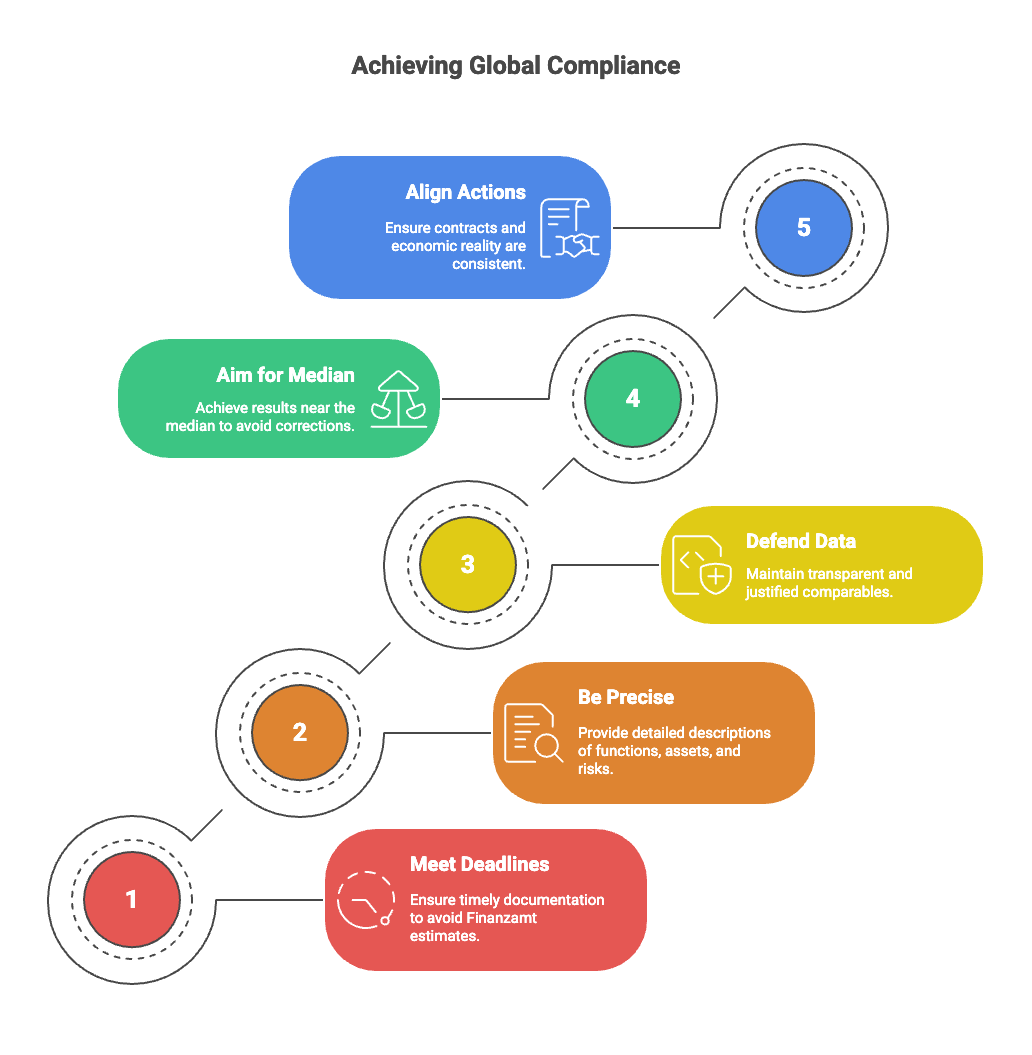
Germany’s transfer pricing regime is unforgiving, but it also offers clear lessons. For MNEs, these lessons translate into habits that protect against adjustments and strengthen global compliance.
- Deadlines are real: documentation must be contemporaneous.
- Be precise: functions, assets, and risks need depth, not vague descriptions.
- Defend your data: comparables must be transparent, consistent, and justified.
- The middle wins: results near the edges often invite correction to the median.
- Actions speak: contracts and economic reality must align.
These rules prove their weight daily in the scrutiny of audits in Germany.
 T1 Advisory perspective: turning complex rules into practical solutions
Germany’s transfer pricing system is built like a precise mechanism: the arm’s length principle, interquartile ranges, secret comparables, and functional analyses all interconnect. On their own, these elements are complex. Together, they form a framework that demands clarity, consistency, and preparation.
At T1 Advisory, we focus on making this framework manageable. By shaping documentation, policies, and operational transfer pricing in advance, we help companies to be compliant.
Beyond audits, the real opportunity is crafting a transfer pricing framework that delivers lasting transparency and supports long-term business objectives.
FAQ
1. Why is the arm’s length principle important for multinational enterprises?
It ensures that intra-group transactions are priced as if between independent parties, preventing profit shifting and safeguarding tax compliance across jurisdictions.
2. How do courts interpret the arm’s length principle in transfer pricing disputes?
German courts test whether pricing reflects economic reality, often confirming adjustments to the median of the interquartile range and allowing secret comparables when reliable.
3. How does Germany apply the arm’s length principle in transfer pricing?
Germany enforces it through binding laws (AStG, AO) and strict documentation rules, requiring taxpayers to prove that cross-border related-party transactions meet arm’s length standards.
4. What is the role of the German tax authorities in transfer pricing?
The Finanzamt conducts audits, reviews documentation, and has the power to adjust taxable income if transactions or evidence deviate from the arm’s length principle.
5. How strict are transfer pricing audits in Germany?
Audits are highly detailed, often lasting years, with particular scrutiny on comparables, intangibles, and financing arrangements; adjustments are frequent if documentation is weak.
6. What penalties exist for poor transfer pricing documentation in Germany?
Penalties can reach up to EUR 1,000,000 plus surcharges, and incomplete documentation may lead to adverse income adjustments determined by the tax authorities.
7. What happens if German transfer pricing documentation is incomplete?
The Finanzamt may reject the taxpayer’s analysis and impose its own estimates, typically less favorable, leading to significant additional tax liabilities.
8. What are “secret comparables,” and how are they used in German audits?
Secret comparables are data available only to tax authorities; German courts allow their use when they provide more reliable benchmarks than public data.
- Deadlines are real: documentation must be contemporaneous.
 T1 Advisory perspective: turning complex rules into practical solutions