


Then and Now: Traditional Financing Structures vs. Contemporary Cash Pooling
Many multinational enterprises (MNEs) assume their financing is efficient because it is compliant and operational. In practice, liquidity is often fragmented across subsidiaries, leaving significant cash balances trapped or underutilized because of legal, tax, regulatory, or operational constraints. Academic research and treasury literature consistently identify inefficient internal liquidity allocation as a common challenge for multinational groups, although the magnitude varies considerably by company.
Liquidity is rarely where it is needed. One entity may hold excess cash, while another is borrowing externally or overrelying on intercompany loans. Traditional structures try to manage this through separate transactions, but they do not address the overall picture.
What looks like a well-organized network of loans and guarantees can result in fragmented liquidity, higher interest costs, and transfer pricing outcomes that do not fully reflect how the business operates.
This is why more groups are moving toward cash pooling. It allows companies to use internal funds more efficiently and reduce external borrowing.
The real question is simple. Does your current financing structure support your business?
Why financing structures have evolved over time
Financing structures in MNEs did not evolve by chance. They changed because the business environment became more complex, more regulated, and much more demanding in terms of cash control.
What used to work in smaller, locally managed groups no longer works at scale. Today, MNEs operate across multiple countries, currencies, and regulatory systems. Money moves constantly, and managing it has become far more complicated.
Because of this, financing is no longer just a back-office function. It is now located at the intersection of operations, tax, and strategy.
From decentralized funding to centralized treasury models
In the past, most MNEs handled financing at the local level. Each entity arranged its own funding, combining external loans with intercompany financing. This worked when operations were simpler and more contained.
As companies grew, the weaknesses of this approach became obvious. Some entities had surplus cash while others needed funding at the same time. Borrowing costs differed from country to country, and there was no clear view of the group’s overall liquidity.
This is why many MNEs moved toward centralized treasury models. Instead of managing financing separately, a central team usually located at the parent company began to coordinate funding, distribute cash, and manage financial risks across the group.
This shift laid the groundwork for more structured solutions, including treasury hubs and, eventually, developed cash pooling structures.
The impact of regulation, tax transparency, and transfer pricing rules
At the same time, the regulatory environment has changed significantly. Tax authorities now expect greater transparency and stronger alignment between financial outcomes and economic activity.
Structures involving intercompany financing, including intercompany loans and guarantees, are no longer assessed only based on pricing. Authorities increasingly examine:
- Whether the financing entity has sufficient substance
- Whether risks are actually controlled and managed
- Whether the allocation of profits reflects real functions
Transfer pricing rules have also become more detailed and more consistently enforced. This means that financing structures must not only be commercially reasonable, but also defensible from a documentation and substance perspective.
As a result, models that were once considered standard now require more careful analysis and ongoing monitoring.
Why liquidity management has become a strategic function
Perhaps the most important shift is how liquidity itself is viewed.
In the past, managing cash was largely operational. The focus was on ensuring that entities had enough funds to meet their current obligations. Today, liquidity is managed at the group level and is closely linked to financial performance. business development and risk management.
Efficient use of liquidity can reduce external borrowing, lower interest costs, and improve overall financial stability. At the same time, poor visibility or fragmented structures can lead to idle cash in one part of the group and unnecessary borrowing in another.
This is why financing structures are no longer just about funding. They are about how effectively a group uses its own resources. Cash pooling has gained attention precisely because it addresses this challenge in a more integrated way.
Traditional financing structures and how they operate
Traditional financing is still widely used in MNEs. It is familiar, relatively easy to set up, and flexible enough to fit different business models. At the same time, its effectiveness depends on how well it reflects the current reality of the business and regulatory environment.
Intercompany loans
The most common tool is still the intercompany loan.
In a simple setup, one entity lends directly to another. Intercompany loan terms are set based on credit worthiness of the borrower, risk assumed by the lender and available market benchmarks leading to a certain interest rate and repayment profile.
In more structured groups, financing is centralized. A financial entity (FinCo) provides funding to multiple subsidiaries, which gives better control over liquidity and simplifies coordination.
In both cases, the expectation is the same. The lender must behave like a real financing entity, and the pricing should reflect what independent parties would agree.
Back-to-back financing arrangements in practice
Some groups use a structure where a central entity borrows externally and then passes the funds to other entities.
This can work well from an operational perspective, but it often raises questions. Tax authorities look closely at whether the central entity actually performs a meaningful functional role and whether its margin is justified.
Intercompany guarantees and comfort letters
Guarantees are also common. A parent company may support a subsidiary to improve its credit profile and reduce borrowing costs.
This support is not neutral from a transfer pricing perspective. If a guarantee leads to better financing terms, it may require compensation. Setting the right guarantee fee is rarely straightforward and usually requires detailed economic analysis.
Advantages of traditional intercompany financing
Traditional structures offer several clear advantages.
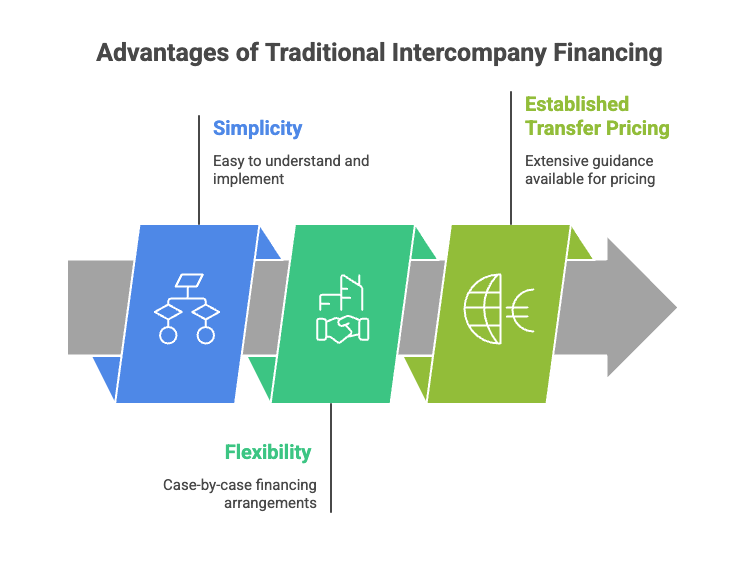
They are relatively simple to understand and implement. Each transaction can be documented individually, and the relationship between lender and borrower is clearly defined.
They also provide flexibility. Financing can be arranged on a case-by-case basis, allowing MNEs to respond to specific needs without restructuring the entire system.
In addition, these structures are well established from a transfer pricing perspective. There is extensive guidance on how to price loans and guarantees, which makes them easier to defend if properly documented, such as Article 9 of the OECD Model Tax Convention 2017, Chapter X of the OECD Transfer Pricing Guidelines 2022 and OECD Transfer Pricing Guidance on Financial Transactions 2020.
Limitations and risks under modern tax frameworks
Despite their advantages, traditional financing structures face increasing challenges.
One of the main limitations is fragmentation. Multiple loans across entities can create a complex network that is difficult to manage and monitor. This often leads to inefficient use of cash and higher overall financing costs.
From a tax perspective, scrutiny has increased. Authorities look beyond the form of the transaction and focus on substance. Questions arise around whether the lending entity truly controls the risks and whether the returns it earns are justified.
There is also a growing focus on consistency. If financing arrangements, financial data, and transfer pricing documentation do not align, this can create exposure during tax audits.
Finally, traditional structures do not always provide a clear view of group-wide liquidity. This makes it harder to optimize cash positions and can result in situations where some entities borrow externally while others hold unused liquidity.
These limitations are one of the key reasons why many MNEs are exploring alternative cash management models such as cash pooling.
Contemporary cash pooling structures explained
Cash pooling is not simply a technical alternative to intercompany loans. It represents a different way of managing liquidity. Instead of treating financing as a series of separate transactions, it treats cash as a shared resource that can be managed at the group level.
This shift changes how funds move, how risks are allocated, and how value is created within the group.
What is a cash pool and how it works in practice
A cash pool is an arrangement where multiple group entities combine their cash balances into a centralized structure, typically managed by a treasury entity or a bank.
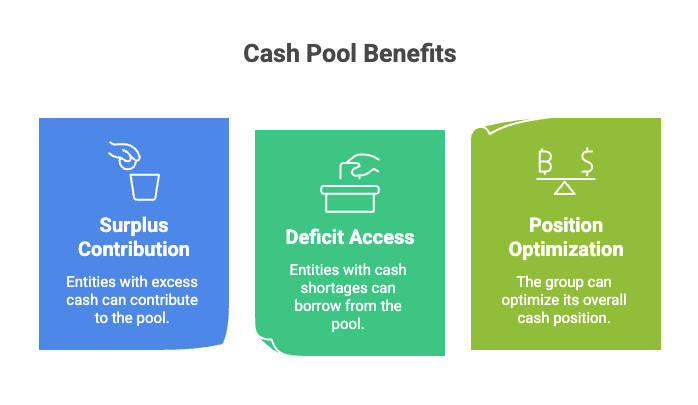
In practice, this allows:
- Entities with surplus cash to contribute liquidity
- Entities with deficits to access funding without external borrowing
- The group to optimize its overall cash position
The key difference from traditional loans is that transactions are not negotiated individually. Instead, positions are aggregated and managed continuously. Interest is typically calculated based on net positions within the pool rather than on standalone loans.
This creates a more dynamic system where liquidity is redistributed automatically, often daily.
Physical cash pooling and notional cash pooling
There are two main types of cash pooling structures, and the choice between them depends on legal, tax, and operational considerations.
- Physical cash pooling, also known as zero balancing, involves the actual transfer of funds. At the end of each day, balances from participating entities are swept into a central account. Entities with deficits receive funds from the same central account.
This structure provides strong control over liquidity and clear visibility of cash positions. However, it may have legal and tax implications, as actual transfers of funds can be treated as intercompany transactions.
- Notional cash pooling, by contrast, does not involve physical transfers. Instead, balances are offset notionally by the bank for interest calculation purposes. Each entity retains its own account, but interest is calculated on the net position across all accounts.
This reduces the need for intercompany transfers, but it often requires more complex banking arrangements and may be subject to regulatory restrictions in certain jurisdictions.
Both models aim to achieve the same goal, but they differ in how risks, ownership of funds, and legal relationships are structured.
Key features of modern cash pool arrangements
Modern cash pooling structures are designed to go beyond basic liquidity management.
They typically include:
- A central treasury function that manages participation, risk, and pricing
- Automated systems that track balances and allocate interest
- Clear rules for how surplus and deficit positions are treated
- Integration with broader financial and risk management processes
Importantly, participation in a cash pool is not neutral. Entities providing liquidity and those using it may have different risk profiles and should be compensated accordingly.
This is where the structure becomes more than operational. It becomes a financing structure that must reflect the economic reality and comply with transfer pricing regulations.
Cash pool transfer pricing considerations
Cash pool transfer pricing is one of the most complex aspects of these arrangements.
Unlike a standard loan, a cash pool involves multiple participants with different roles. Some entities act as lenders, others as borrowers, and the pool leader may perform coordination and risk management functions.
From a transfer pricing perspective, this raises several key questions:
- How to allocate the benefit of reduced external borrowing costs
- How to determine appropriate interest rates for participants
- Whether the cash pool leader should earn a service fee, a spread, or a risk-based return
Tax authorities increasingly expect that these questions are addressed explicitly. Simply applying a single interest rate across all cash pool participants is rarely sufficient.
In addition, the allocation of risk is critical. If the pool leader is assumed to manage liquidity and credit risk, it must demonstrate the capability to do so. Otherwise, its remuneration may be challenged.
This makes cash pooling structures highly efficient when designed properly, but also highly sensitive from a transfer pricing perspective.
The financing structure in practice
There is no universal answer to whether traditional financing or cash pooling is the best model. The right structure depends on how the business operates, how cash flows through the group, and what level of complexity the organization can manage.
The key is not to follow trends, but to align the structure with the underlying business reality.
Key factors: size, geography, currency exposure, and operational model
Several factors determine which structure is appropriate.
Group size plays a major role. Larger MNEs with multiple entities and significant volume of intercompany cash flows are more likely to benefit from centralized models.
Geographic footprint is equally important. Cross-border cash pooling may imply regulatory restrictions or more tax complex in certain jurisdictions, which can limit the feasibility of specific structures.
Currency exposure also matters. Groups operating in multiple currencies need to consider how exchange risks are managed within the pool, and how to structure their cash pool efficiently, choosing from single-currency pools and multi-currency pools.
Finally, the operational model of the business influences the choice. Beyond a simple centralized versus decentralized distinction the key determinants are the degree of treasury control, governance over subsidiaries, and the level of process and system standardization. MNEs with strong central treasury functions and standardized banking structures may benefit more from the implementation of the cash pool. In contrast, groups with more autonomous subsidiaries may face practical and organizational constraints, making traditional financing arrangements more suitable.
When traditional financing structures are still effective
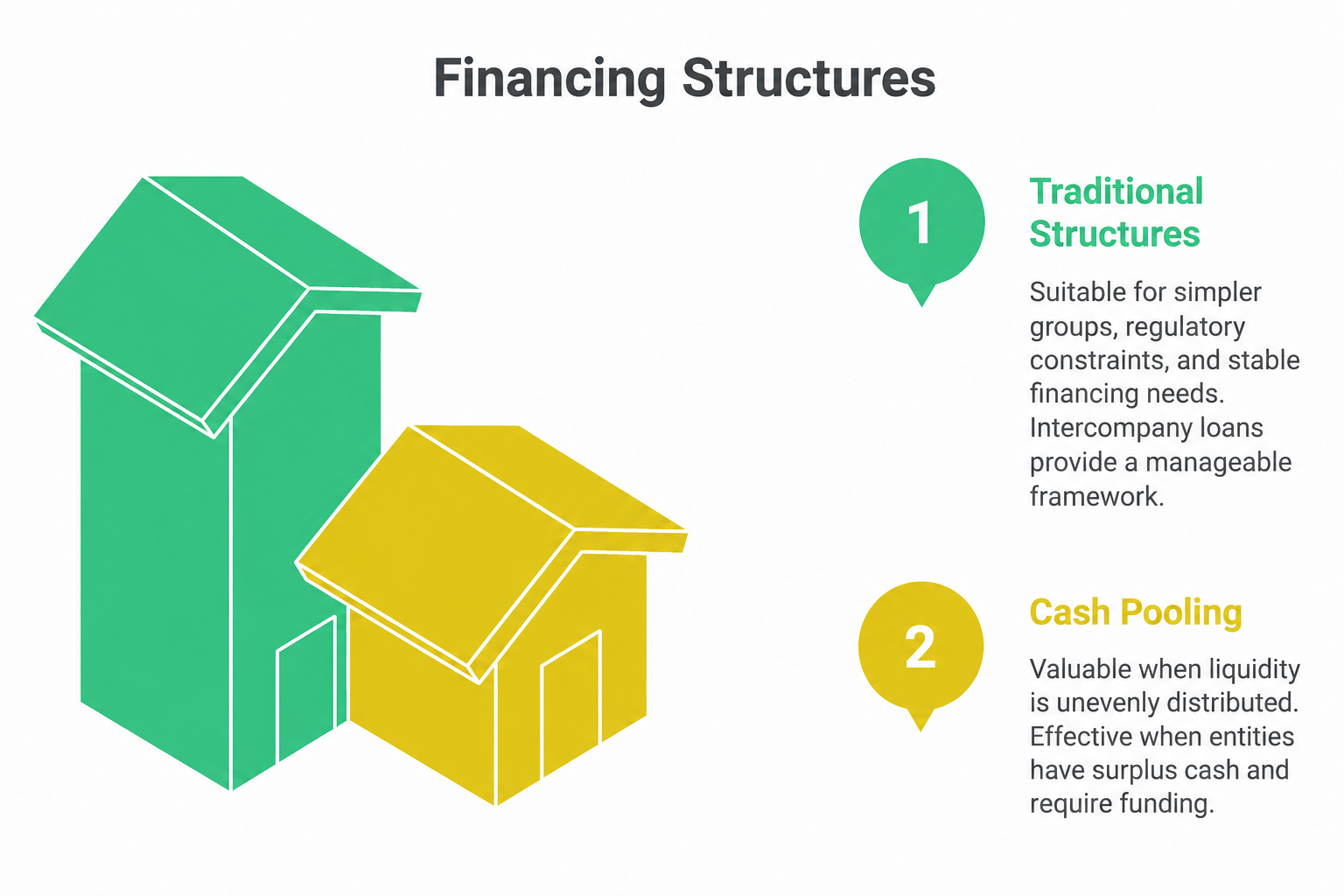
Traditional structures remain effective in several scenarios.
They are often suitable for:
- Smaller groups with limited internal cash flows,
- Situations where regulatory constraints make pooling impractical,
- Cases where financing needs are stable and predictable.
In these cases, intercompany loans provide a clear and manageable framework without introducing unnecessary complexity.
They can also be appropriate where entities operate independently and require distinct financing arrangements.
When cash pooling provides a clear advantage
Cash pooling becomes particularly valuable when liquidity is unevenly distributed across the group.
It is most effective when:
- Some entities consistently hold surplus cash, while others require funding
- The group aims to reduce external borrowing and optimize internal resources
- There is a need for real-time visibility and control over cash positions
In such cases, cash pooling can reduce financing costs, improve efficiency, and provide greater flexibility in managing liquidity.
However, these benefits depend on proper design and implementation. Without this, the structure can only create more complexity.
 Hybrid approaches and transition strategies
 Hybrid approaches and transition strategies
In practice, many MNEs adopt a combination of both models.
For example:
- A cash pool may be used for short-term liquidity management,
- Intercompany loans may still be used for long-term funding.
This hybrid approach allows MNEs to benefit from the efficiency of cash pooling while maintaining the stability of traditional financing.
Transitioning to such a model requires careful planning. Existing structures need to be reviewed, documentation updated, and systems aligned.
The transition itself is often where risks arise, particularly if changes are made without fully considering transfer pricing and tax regulatory implications.
Opportunities and risks in 2026 financing structures
As financing structures continue to evolve, the balance between opportunity and risk becomes more pronounced.
The same features that make cash pooling efficient also make it more visible and more closely scrutinized.
Transfer pricing risks in cash pooling
Cash pooling structures attract attention because they redistribute financial benefits across the MNEs.
Tax authorities may focus on whether:
- Interest rates reflect the roles of participants,
- Benefits are allocated appropriately,
- The cash pool leader is compensated in line with performed functions and assumed risks.
If these elements are not properly aligned, adjustments may be made, leading to additional tax exposure.
The complexity of these structures increases the likelihood of inconsistencies, particularly where data, documentation, and actual cash flows do not fully match.
Regulatory and substance requirements
Regulation is another critical factor.
Certain jurisdictions impose restrictions on cash pooling, particularly in relation to:
- Cross-border fund transfers,
- Participation of specific entities,
- Banking and treasury activities.
In addition, substance requirements have become stricter. Entities involved in financing must demonstrate that they have the capacity to perform the functions attributed to them.
This is particularly relevant for treasury companies and cash pool leaders.
Risk of mispricing and hidden financial benefits
One of the more subtle risks is mispricing.
In a cash pool, benefits arise from reduced borrowing costs and improved use of liquidity. These benefits must be allocated between participants in a way that reflects their contributions and risks.
If this allocation is not carefully designed, some entities may receive hidden financial advantages, while others are not adequately compensated.
This can lead to transfer pricing challenges, even if the structure appears operationally efficient.
In practice, the risk is not always visible immediately. It often emerges during tax audits, when authorities analyze how the structure operates over time.
This is why the design of financing structures must go beyond functionality. It must also ensure that outcomes are consistent, defensible, and aligned with the economic reality of the group.
Supporting cash pool transfer pricing and documentation
Cash pooling requires a different level of precision.
Documentation plays a central role. We ensure that transfer pricing documentation reflects how the cash pool operates in practice, not only how it is designed.
This alignment between structure, data, and documentation is what allows the model to withstand scrutiny.
Frequently Asked Questions
1. What is the difference between cash pooling and intercompany loans?
Cash pooling centralizes liquidity across the group, while intercompany loans finance entities through separate bilateral transactions.
2. How does cash pool transfer pricing work in practice?
It allocates interest and financial benefits between participants based on their roles, contributions, and risks within the pool.
3. When should a company consider implementing a cash pooling structure?
When there is uneven liquidity across entities and a need to reduce external borrowing and improve cash visibility.
4. Are intercompany loans still relevant for multinational groups?
Yes, especially for long-term financing or where regulatory or operational constraints limit the use of cash pooling.
5. What are the main risks in cash pooling structures?
Key risks include incorrect pricing, misallocation of benefits, and lack of alignment between structure and economic substance.
6. How are intercompany guarantees treated from a transfer pricing perspective?
They may require a guarantee fee if they provide a measurable financial benefit to the borrower.
7. What is the role of the cash pool leader?
The cash pool leader coordinates liquidity, manages risks, and may earn a return margin depending on its functions and responsibilities.
8. Can cash pooling reduce financing costs?
Yes, by offsetting surplus and deficit positions, it reduces the need for external borrowing and improves overall efficiency.
9. What factors determine the choice between traditional financing and cash pooling?
Key factors include group size, complexity, geographic footprint, currency exposure, and the level of treasury centralization.
10. How can T1 Advisory support cash pooling implementation?
T1 Advisory helps price and document structures to ensure they are efficient, compliant, and aligned with actual business operations.
