


Integrating Sustainability Targets into Transfer Pricing Models
A company may change suppliers after Environmental, Social, Governance (ESG) reviews, relocate part of its manufacturing to reduce transportation emissions, and starts investing in renewable energy.
On paper, these look like operational decisions. In reality, they often change how costs, risks, and profits should be allocated across the group.
That is usually the moment transfer pricing teams get involved.
Sustainability now affects procurement structures, supply chains, manufacturing functions, and even ownership of intangible assets inside multinational enterprises (MNEs).
As these changes spread across jurisdictions, many groups revisit their transfer pricing model to make sure intercompany arrangements still reflect how the business actually works.
At the same time, regulators increasingly compare ESG disclosures, financial reporting, and international tax reporting in parallel, especially in industries subject to growing environmental scrutiny.
Where Sustainability Meets Transfer Pricing
Companies are frequently surprised by how fast sustainability strategies change the way they operate. Supplier networks may change after ESG audits. Manufacturing moves closer to consumer markets to reduce logistics burden and transportation CO2 emissions. Regional entities begin managing ESG reporting or supplier oversight across several jurisdictions.
As these changes take effect, transfer pricing arrangements often fail to keep pace with evolving business operations.
A company previously treated as a routine entity may change its functional profile and start to control supplier compliance programs, environmental reporting, or sustainability governance functions affecting multiple markets. Tax authorities increasingly expect intercompany pricing to reflect these changes in functions, risks, and decision-making responsibility.
Why sustainability affects the way companies allocate costs, risks, and profits
ESG-related investments rarely benefit only one entity.
A multinational group may finance a decarbonization project centrally, implement it through local operations, and use the improved ESG profile globally in discussions with investors, regulators, and customers. That immediately creates transfer pricing questions:
- who bears the costs,
- which entity controls the risks,
- where long-term value is created,
- how future profits should be allocated.
The sensitivity of these issues increases when sustainability measures influence operating performance and competitive positioning in multiple jurisdictions at once.
The connection between sustainable business practices and intercompany pricing
Many transfer pricing issues begin with operational decisions rather than thorough tax planning.
When a company introduces stricter supplier screening requirements, the procurement teams start managing sustainability audits and environmental compliance checks across multiple countries.
Over time, the regional procurement entity may start performing far more strategic functions than before, while the transfer pricing model may still compensate for it as routine support.
The same applies to manufacturing. A group production entity investing in renewable energy infrastructure may reduce operating costs significantly, while another company inside the group may benefit from the group’s stronger ESG positioning or improved commercial relationships.
As a result, sustainable business practices increasingly influence:
- procurement remuneration,
- manufacturing margins,
- cost contribution arrangements,
- intercompany service fees,
- intellectual property structures.
How investor expectations and public reporting shape tax transparency discussions
ESG reporting is now closely tied to tax transparency.
Investors and regulators increasingly compare sustainability disclosures with transfer pricing documentation, financial reporting, and operational structures. If a company publicly highlights sustainable investment or ESG-oriented operations in a particular jurisdiction, tax authorities may later examine whether the reported profit allocation reflects those reports.
This becomes particularly important in industries exposed to environmental scrutiny, such as energy, manufacturing, logistics, retail, and consumer goods.
Tax authorities also review ESG disclosures and public financial statements as part of the same broader transparency picture.
Transfer pricing teams increasingly work alongside finance, legal, and ESG departments. Why?
Information from across the business increasingly plays a key role in transfer pricing.
Sustainability teams manage ESG targets and supplier compliance. Finance departments control cost allocation and financial reporting. Legal teams oversee contracts, governance structures, and intellectual property ownership. Once these functions evolve separately, inconsistencies appear quickly, creating governance and tax risks.
An ESG report may describe one entity as leading a major sustainability initiative, while intercompany agreements place the related risks elsewhere. Procurement teams may restructure supplier relationships without updating transfer pricing policies in result.
For many MNEs, sustainability and transfer pricing have therefore become closely connected governance issue, requiring closer coordination than in the past.
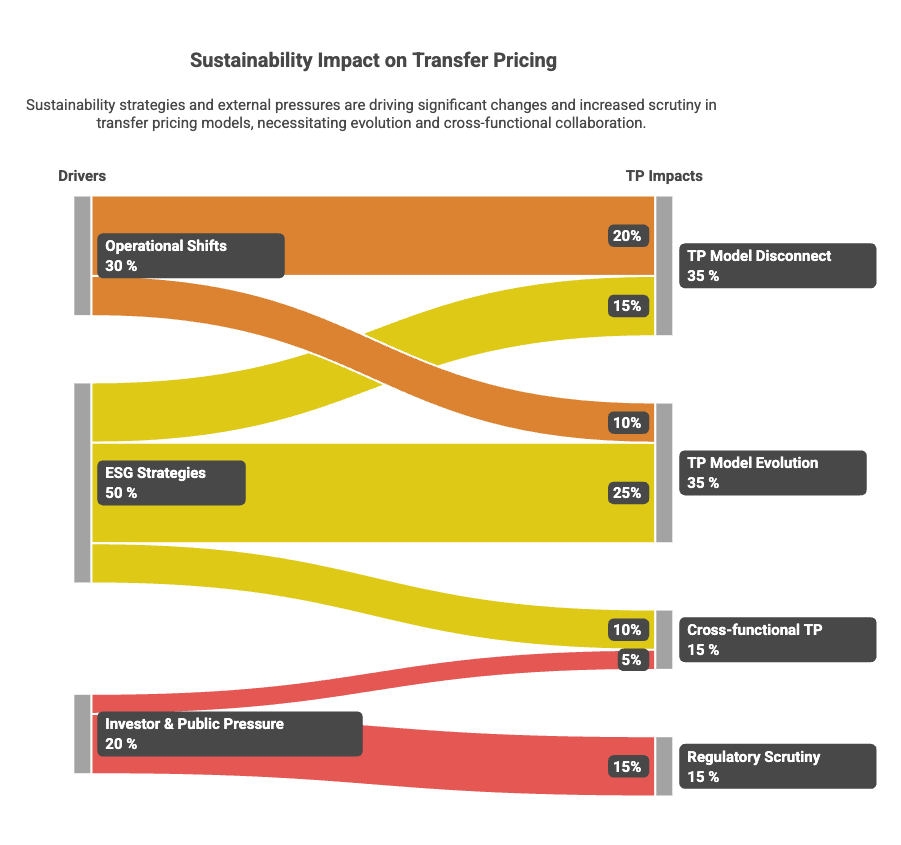
Sustainable Supply Chains and Intercompany Transactions
Companies are redesigning supply chains to address sustainability targets, regulatory pressures, and rising operational costs.
Many MNEs now reduce supplier concentration, move production closer to consumer markets, or shift operations to jurisdictions with stronger infrastructure and lower environmental exposure. Such decisions frequently create major changes in intercompany arrangements and relationships.
For instance, a principal entity that once performed a fully-fledged manufacturing role may transfer operational responsibilities to regional companies. Procurement hubs may begin managing supplier sustainability oversight across several markets. Distribution entities may take on local ESG compliance functions connected to packaging, sourcing, or environmental reporting.
Once functions and risks move between entities, existing transfer pricing models often become difficult to defend during audits.
Environmental compliance costs and their allocation between related entities
Environmental compliance has become a major operating expense for large MNEs.
Businesses increasingly invest in:
- emissions monitoring systems,
- environmental certifications,
- supplier sustainability audits,
- carbon reduction programs,
- waste management infrastructure,
- ESG reporting requirements.
In most cases, the difficulty lies not in the expense itself, but in determining how the group should reallocate it internally.
A regional headquarters may coordinate environmental compliance programs for several subsidiaries at once. A procurement entity may manage supplier sustainability reviews, benefiting operations across multiple jurisdictions. In some cases, one entity incurs costs associated with strengthening the ESG profile of the entire group.
Tax authorities increasingly expect businesses to explain why certain entities receive economic benefit from these activities and whether the allocation methodology reflects commercial reality.
Decarbonization investments, renewable energy projects, and shared operational expenses
Large sustainability investments rarely benefit one entity alone.
A renewable energy project may support manufacturing operations across several jurisdictions simultaneously.
An energy-efficiency program may reduce operating costs group-wide. Decarbonization initiatives may improve relationships with customers, investors, lenders, and regulators at the same time.
That creates immediate transfer pricing questions:
- who owns the investment,
- which entities benefit economically,
- whether costs should be centralized or funded locally,
- how future profits and other economic synergies should be allocated.
Sustainability investments can turn these issues into highly sensitive matters once they affect margins and strategic direction.
Responsible sourcing strategies and regional manufacturing shifts
Responsible sourcing now influences procurement strategy across a wide range of international industries.
Businesses that operate close to consumers face growing expectations around labor practices, sustainability standards, supplier oversight, and traceability throughout their supply chains. In some cases, this has pushed many groups to procurement restructuring or production shifts alongside broader considerations such as cost, resilience, infrastructure quality, and energy availability.
These operational changes directly affect transfer pricing structures.
A procurement entity managing supplier sustainability audits across multiple markets may perform significantly more valuable functions than under a traditional low-risk procurement model. A regional manufacturing company operating under strict environmental standards may also assume additional operational responsibilities and compliance risks compared to similar entities elsewhere in the group. If it controls and bears economically significant risks, then it is entitled to a higher compensation compared to a routine entity.
The practical impact of sustainability targets on intercompany agreements
Sustainability initiatives often move faster than internal compliance documentation. Several changes can occur without immediate updates to intercompany agreements.
For example, a contract manufacturer may suddenly become responsible for emissions reporting. A distributor may assume ESG-related supplier oversight obligations. Regional service entities may begin coordinating sustainability governance across several jurisdictions.
Yet many intercompany agreements still reflect business structures created years earlier.
A common challenge in transfer pricing reviews is that contracts, operational behavior, ESG reporting, and pricing policies present different stories.
Tax authorities increasingly examine whether intercompany agreements actually reflect the way sustainability-related functions, risks, and responsibilities are managed across the group.
Green Intangibles and ESG-Driven Value Creation
Some of the most valuable sustainability-related assets are not recognized directly on a balance sheet. They exist as clean technology patents, low-emission production methods, proprietary recycling systems, sustainability-focused software, or ESG-driven brand positioning.
These assets are often described as green intangibles, and they create increasingly complex transfer pricing questions for MNEs.
A company may legally own environmentally focused intellectual property in one jurisdiction while development, operational control, and commercial exploitation take place somewhere else entirely.
Since sustainability-related value is often created jointly across multiple entities, tax authorities increasingly focus on who funded the development, who bears and controls the risks, where strategic decisions are taken, and which entities gain commercially from the arrangement.
Clean technology patents, sustainable product development, and environmental innovation
Environmental innovation now directly affects competitiveness across sectors such as manufacturing, automotive, technology, retail, and energy.
MNEs invest heavily in:
- energy-efficient production systems,
- sustainable packaging,
- emissions-reduction technologies,
- renewable infrastructure,
- environmentally focused R&D.
The transfer pricing challenge begins once these investments generate measurable business value.
A company developing sustainable technology may strengthen market access, reduce regulatory exposure, improve financing conditions, or increase customer retention at the same time. Yet the functions that create this value are rarely concentrated within a single entity. Research teams may develop the technology, manufacturing entities may implement it, and commercial teams may translate sustainability achievements into customer demand.
Compared to traditional IP structures, this creates a much more difficult valuation process.
ESG-related brand value and reputation-driven intangible assets
In some industries, a sustainability reputation has become commercially valuable on its own.
A consumer brand associated with responsible sourcing may strengthen negotiation and pricing power. A manufacturer with lower environmental exposure may secure better commercial relationships with large corporate buyers. ESG performance increasingly influences procurement decisions, investor perception, and long-term market positioning.
The problem is that this value develops gradually across the business:
- procurement teams improve supplier standards,
- sustainability departments manage ESG targets,
- operations reduce environmental exposure,
- marketing teams communicate the outcome publicly.
Over time, businesses must decide whether existing transfer pricing structures still reflect how ESG-related brand value is actually created inside the group.
Environmental Factors Affecting Transfer Pricing
Carbon pricing and emissions-related operating costs
Carbon pricing already affects operational decisions across manufacturing, logistics, transportation, and energy sectors.
Once emissions-related costs begin influencing margins, transfer pricing questions follow quickly:
- which entity is economically responsible for environmental costs,
- whether sustainability expenses should be shared,
- how carbon-related operational changes affect profitability.
A particularly sensitive situation arises where environmental compliance materially changes the economics of production or supply chain management. In such cases, transfer pricing policies may need to be reassessed to determine whether existing allocations of costs, and risks and returns remain consistent with the group’s actual operating model.
Allocation of sustainability investments across jurisdictions
A renewable energy project may support several business operations simultaneously. A centralized environmental compliance platform may reduce regulatory exposure group-wide. Supplier sustainability programs may improve procurement conditions across multiple jurisdictions.
Tax authorities increasingly expect businesses to explain:
- why entities receive certain economic benefit,
- how costs are allocated,
- whether the structure reflects operational reality.
Weak allocation logic becomes highly visible during transfer pricing audits, especially where sustainability spending materially affects profitability.
Social Factors To be Taken into Account
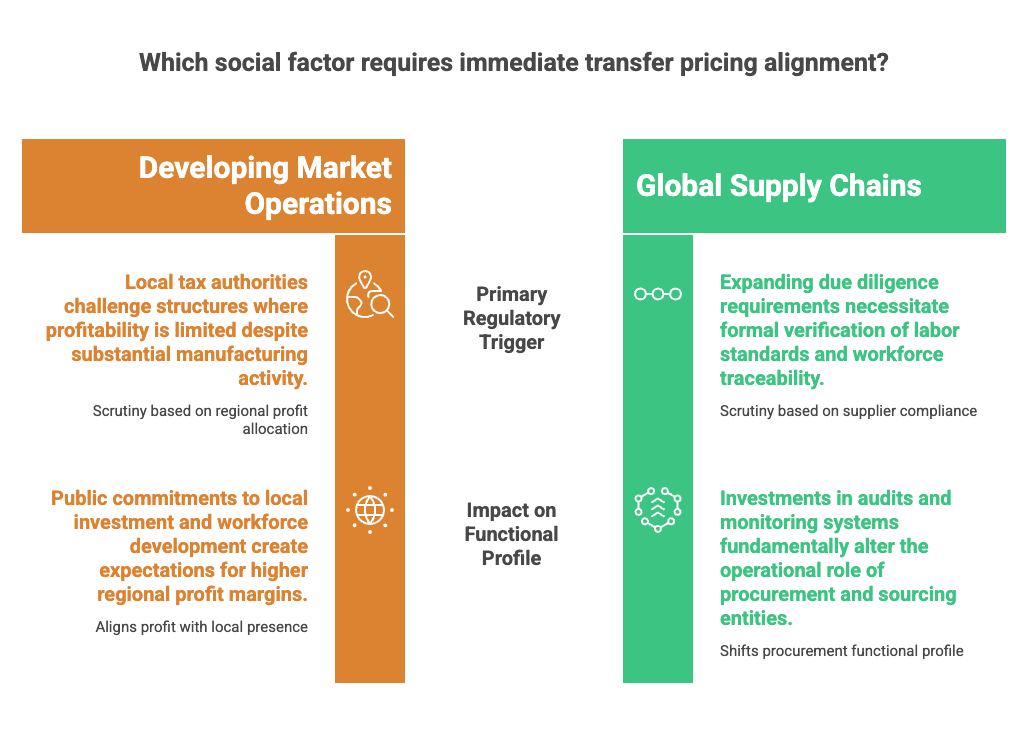
Fair profit allocation in developing markets
Tax authorities in developing markets increasingly challenge structures where substantial manufacturing or sourcing activity exists locally, but profitability remains limited.
Particular sensitivity arises when companies publicly report:
- local investment,
- workforce development,
- responsible sourcing commitments,
- long-term regional presence.
If transfer pricing outcomes appear inconsistent with those statements, scrutiny tends to increase quickly.
Ethical labor expectations across global supply chains
Supplier due diligence requirements continue expanding across manufacturing, retail, and consumer industries.
Businesses increasingly invest in:
- supplier audits,
- labor standards verification,
- workforce traceability,
- sustainable compliance monitoring systems.
These activities often may change the functional profile of procurement and sourcing entities inside MNEs, particularly where supplier oversight becomes strategically important to the business.
The relationship between sustainability commitments and responsible taxation
Corporate tax behavior increasingly forms part of broader ESG discussions.
Investors, regulators, and stakeholders now examine whether sustainability messaging aligns with overall financial structures and profit allocation models. Transfer pricing, therefore, becomes part of a wider governance conversation connected to transparency, commercial substance, and long-term corporate credibility.
Governance, Transparency, and Regulatory Pressure
Transparency in intercompany transactions and reporting
Transfer pricing documentation no longer exists in isolation. Tax authorities compare transfer pricing documentation, with a wide range of corporate disclosure, such as ESG reports, operational disclosures, procurement structures, and public financial statements.
That broader visibility changes the level of scrutiny MNEs face.
A company may publicly describe one jurisdiction as strategically important to its sustainability strategy, while transfer pricing documentation presents the same entity as performing only routine support functions. Situations like this can raise questions about consistency of business operations.
As ESG reporting becomes more detailed, businesses have fewer opportunities to separate sustainability messaging from underlying tax structures. This places greater importance on cross-functional coordination between tax, finance, legal, procurement and sustainability teams to maintain a consistent narrative across all forms of corporate reporting.
Why consistency between ESG disclosures and transfer pricing documentation matters
Inconsistencies rarely stay hidden for long.
If a business publicly highlights sustainable manufacturing investment, supplier oversight programs, or regional operational leadership, regulators increasingly expect those activities to appear consistently across:
- transfer pricing documentation,
- intercompany agreements,
- financial reporting,
- operational governance structures.
The issue is not simply technical compliance. It is whether the overall business narrative reflects the way value is actually created inside the group.
OECD BEPS initiatives and global tax governance expectations
OECD BEPS initiatives significantly increased expectations around transparency, economic substance, and alignment between profits and real business activity.
Sustainability-related value creation adds another layer of complexity to that discussion.
Tax authorities increasingly examine:
- where ESG-related decision-making takes place,
- which entities control sustainability investments,
- how environmental costs affect profitability,
- whether transfer pricing outcomes reflect operational substance.
For multinational groups, governance expectations now extend well beyond benchmark studies and standard documentation exercises.
Pillar One and Pillar Two implications for multinational enterprises
Pillar One and Pillar Two continue expanding the amount of operational and financial information MNEs must monitor across jurisdictions.
For groups heavily involved in sustainability-driven restructuring, this creates additional pressure to maintain consistency between:
- transfer pricing policies,
- ESG disclosures,
- global reporting obligations,
- effective tax outcomes.
Complex supply chain changes, renewable energy investments, and centralized ESG functions can all influence how profits, costs, and tax exposure are evaluated under evolving international tax frameworks.
Risks Linked to ESG and Transfer Pricing Misalignment
Tax authority scrutiny and transfer pricing adjustments
Tax authorities increasingly view ESG disclosures as a source of operational evidence.
A sustainability report describing significant manufacturing functions, supplier oversight responsibilities, or regional ESG leadership may later influence the way regulators evaluate transfer pricing structures during audits.
This creates higher exposure to:
- transfer pricing adjustments,
- disputes over profit allocation,
- challenges to limited-risk structures,
- double taxation risks.
The more detailed ESG reporting becomes, the easier it is for regulators to compare public statements against tax documentation.
Conflicts between sustainability messaging and financial structures
Some of the strongest transfer pricing risks appear when public sustainability messaging conflicts with the group’s actual financial structure.
A business may emphasize responsible local investment while reporting limited profitability in the same jurisdiction. Another company may publicly position sustainability as a core strategic function while the entities performing those activities receive only routine remuneration under existing transfer pricing models.
These contradictions tend to attract attention quickly because they affect both governance credibility and tax transparency discussions simultaneously.
Reputational exposure connected to aggressive tax positioning
Corporate tax behavior increasingly influences ESG perception.
Investors, lenders, and business partners now examine whether sustainability commitments align with broader financial structures and profit allocation models. Aggressive tax positioning may therefore create reputational pressure even where technical compliance exists.
Audit risks in industries with significant environmental impact
Industries with high environmental exposure often face more intensive transfer pricing scrutiny once ESG issues become financially material.
This includes:
- energy,
- manufacturing,
- mining,
- transportation,
- industrial production,
- consumer goods.
Large environmental investments, emissions-related costs, and sustainability-driven restructuring frequently create complex allocation questions that tax authorities examine closely during audits.
Internal governance challenges across MNEs
Many ESG-related transfer pricing problems begin internally rather than during tax audits.
Operational teams may restructure supply chains without contemporarily updating transfer pricing models. Intercompany agreements may remain unchanged despite major operational shifts connected to ESG strategy.
Over time, governance gaps create documentation inconsistencies that become increasingly difficult to defend externally.
Opportunities Created by Sustainable Transfer Pricing
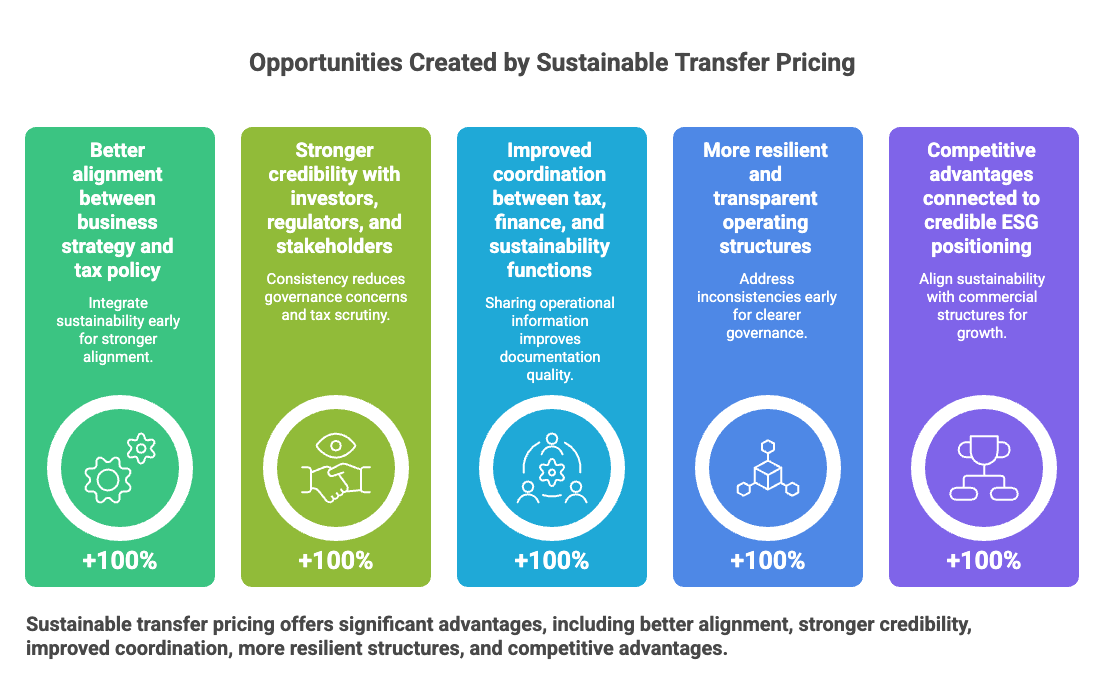
Better alignment between business strategy and tax policy
MNEs that integrate sustainability considerations into their transfer pricing models early usually gain stronger alignment between operational decision-making and tax governance.
Companies can achieve more sustainable transfer pricing outcomes by structuring cost allocation models, intercompany agreements, procurement arrangements, and intangible asset ownership around the actual commercial realities of the business contemporaneously.
Stronger credibility with investors, regulators, and stakeholders
Consistency matters.
When ESG disclosures, operational structures, and transfer pricing documentation all describe the same commercial reality, businesses tend to face fewer governance risks.
Transparent structures also reduce the risk of sustainability messaging creating unintended tax scrutiny later.
Improved coordination between tax, finance, and sustainability functions
Many MNEs discover that sustainability projects improve internal governance once departments begin sharing operational information more consistently.
Transfer pricing teams gain better visibility into supply chain changes, ESG investments, and functional restructuring. Sustainability teams develop a clearer understanding of how operational initiatives affect financial and tax reporting.
That coordination often improves documentation quality across the organization as a whole.
More resilient and transparent operating structures
Sustainability-driven transfer pricing reviews frequently reveal outdated structures that no longer match operational reality.
Businesses that address those inconsistencies early generally build:
- clearer governance frameworks,
- stronger documentation processes,
- more transparent reporting structures,
- better operational oversight across jurisdictions.
The value of this approach continues to grow as reporting requirements increase worldwide.
Competitive advantages connected to credible ESG positioning
Credible ESG positioning increasingly depends on operational consistency rather than public messaging alone.
Companies able to align sustainability commitments with commercial structures, governance frameworks, and transfer pricing policies often strengthen:
- investor confidence,
- financing access,
- supplier relationships,
- regulatory credibility,
- long-term market positioning.
In practice, sustainable transfer pricing is becoming less about technical compliance and more about demonstrating that the business structure genuinely reflects how value is created across the group.
Building a Practical ESG-Aligned Transfer Pricing Strategy
Mapping ESG-Related Costs, Functions, and Value Drivers
Many businesses realize surprisingly late that sustainability initiatives have already changed the economics of the group.
A procurement entity begins managing supplier sustainability audits. A regional headquarters coordinates ESG reporting across several jurisdictions. Manufacturing companies take on additional environmental compliance responsibilities. Gradually, functions, risks, and decision-making shift — while transfer pricing policies remain tied to the old structure.
The first practical step is understanding where sustainability-related value is actually created.
That usually includes environmental compliance functions, ESG reporting responsibilities, supplier oversight, renewable energy investments, sustainability-focused R&D, and operational governance roles.
Once these functions start influencing profitability, tax authorities generally expect transfer pricing outcomes to reflect the commercial reality behind them.
Without this analysis, businesses often end up with documentation that no longer matches the way the organization actually operates.
Evaluating Green Intangibles and ESG-Driven Value Creation
Green intangibles become commercially important much faster than companies expect.
An MNE may develop low-emission manufacturing processes, sustainability-focused software, environmentally driven product design, or internal ESG compliance systems. Over time, these assets influence operating margins, financing conditions, customer relationships, investor perception, and long-term market positioning simultaneously.
The transfer pricing challenge is determining where that value is actually created.
In practice, sustainability-related intangible value is often spread across several jurisdictions at once. One entity funds development, another controls implementation, while operational teams elsewhere generate the commercial benefit. That complexity makes ESG-driven value creation significantly more difficult to evaluate than traditional intellectual property structures.
Aligning Tax, Sustainability, and Transfer Pricing Functions
Most ESG-related transfer pricing issues begin with disconnected internal reporting.
Sustainability teams describe one entity as leading a major ESG initiative. Transfer pricing documentation characterizes the same company as routine entity. Procurement structures evolve, but intercompany agreements stay unchanged. Finance teams allocate costs using assumptions that operational teams stopped following months earlier.
That disconnect creates risk quickly because regulators increasingly compare ESG disclosures, financial reporting, and transfer pricing documentation as part of the same broader governance picture.
Businesses, therefore, need stronger coordination between tax, finance, legal, procurement, and ESG functions so reporting remains commercially consistent across the group.
How T1 Advisory Supports ESG-Aligned Transfer Pricing Strategies
Most ESG-related transfer pricing problems do not begin inside the tax department.
Procurement changes suppliers after sustainability reviews. Manufacturing shifts closer to key markets. A regional entity starts managing ESG reporting across several jurisdictions. Renewable energy investments appear in one country while commercial benefit spreads across the group.
A few quarters later, the documentation no longer matches the business.
T1 Advisory works with MNEs on transfer pricing and international tax matters connected to sustainability-driven operational change.
Our approach focuses on operational reality:
- how decisions are actually made,
- where functions shifted over time,
- which entities control risks,
- whether transfer pricing outcomes still reflect the way value is created across the group.
Updating Documentation and Monitoring Regulatory Developments
Sustainability-related operational changes often move faster than documentation updates.
Over time, documentation gaps become difficult to defend during audits.
Businesses increasingly need transfer pricing frameworks capable of reflecting sustainability-related functions, environmental cost allocation, ESG governance structures, operational restructuring, and evolving international reporting obligations in a consistent and commercially supportable way.
Reviewing ESG Changes Before They Create Tax Exposure
Operational changes linked to ESG initiatives often appear in the business long before they appear in transfer pricing documentation.
T1 Advisory supports MNEs to identify gaps between operational reality, intercompany arrangements, and profit allocation across jurisdictions before these issues surface during audits or regulatory review.
Your Questions, Our Answers
1. How does sustainability affect transfer pricing policies?
Sustainability changes how MNEs allocate costs, risks, functions, and profits between related entities.
2. What are green intangibles?
Green intangibles are sustainability-related assets such as clean technology patents, low-emission processes, ESG-focused software, and environmentally driven brand value. They may matter for transfer pricing purposes.
3. Why do ESG disclosures increase transfer pricing risks?
Tax authorities increasingly compare ESG reports with transfer pricing documentation and operational structures to identify inconsistencies.
4. How are carbon-related costs allocated between entities?
Carbon-related costs are usually allocated based on economic benefit, operational responsibility, and risk control.
5. Which industries face the highest ESG-related transfer pricing exposure?
Energy, manufacturing, transportation, mining, industrial production, retail, and consumer goods sectors generally face the highest sustainability-related transfer pricing scrutiny.
6. How can companies align sustainability goals with transfer pricing strategy?
Businesses usually begin by reviewing ESG-related functions, reassessing value creation, and updating transfer pricing documentation to reflect operational reality.
