


How Pillar Two shapes current transfer pricing compliance requirements: Managing the GloBE Effective Tax Rate in a Post-BEPS 2.0 World
Many multinational entities (MNEs) are now facing a surprising challenge: their transfer pricing policies seem fully compliant, yet their global effective tax rate (ETR) falls below 15 percent. Under Pillar Two requirements, this gap triggers additional tax, often in jurisdictions that were not previously considered high risk.
What happens when a company follows transfer pricing rules correctly but still ends up paying more tax? This is no longer a theoretical question. In practice, the issue is rarely a single transaction or structure. More often, it reflects a deeper misalignment between financial data, transfer pricing policies, and Global Anti-Base Erosion Model (GloBE) calculations.
Under Pillar Two, the global minimum tax rate introduces a second lens through which profit allocation is assessed. As a result, traditional compliance no longer guarantees optimal outcomes. Businesses must now actively manage how transfer pricing decisions influence their GloBE ETR, which often requires a far more integrated and data-driven approach across tax, finance, and reporting functions.
What is Pillar Two and why it matters today
The Pillar Two Model Rules (also called GloBE rules), released on 20 December 2021 are a part of the Two-Pillar Solution to address the tax challenges of the digitalisation of the economy. The implementation of the GloBE rules at EU level took place with the adoption of the EU Directive 2022/2523 in December 2022.
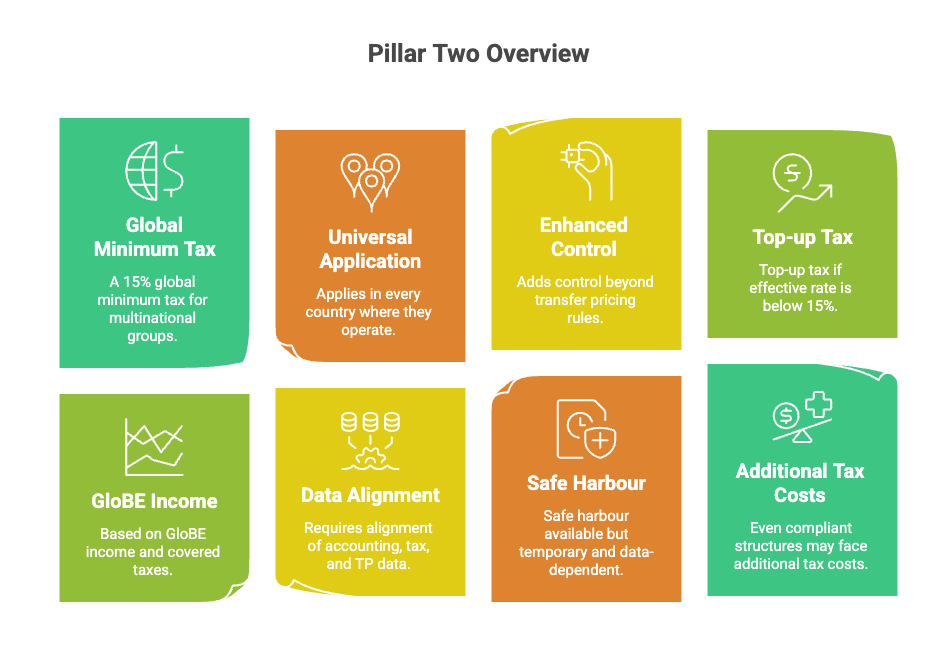
In general, Pillar Two is a global tax framework developed by the OECD as part of the BEPS 2.0 initiative. Its main idea is simple: large MNEs should pay a minimum level of tax on income arising in each jurisdiction where they operate.
However, the way this is enforced is far from simple. Pillar Two does not change how profits are allocated between entities. Instead, it adds a second layer of control. Even if profits are allocated correctly under transfer pricing regulations, tax authorities now analyse whether those profits are taxed at a high enough level.
If they are not, an additional tax (also called top-up tax) will be applied.
Understanding the 15 percent global minimum tax rate
The global minimum tax rate works as a safety net. Each jurisdiction where a group operates is tested separately.
The GloBE rules apply a system of top-up taxes that brings the total amount of taxes paid on an MNE’s excess profit in a jurisdiction up to the minimum rate of 15 percent.
Therefore, if the effective tax rate in a country is below 15 percent, the difference must be paid as a top-up tax.
For example:
- A company earns profit in a country with a 10 percent tax rate,
- The required minimum is 15 percent,
- The group must pay an additional tax of 5 percent.
This applies even if the structure is fully compliant from a transfer pricing perspective. This is why many companies are now facing unexpected tax compliance costs.
How GloBE income, covered taxes, and effective tax rate are calculated
To determine whether additional tax is due, Pillar Two uses its own calculation logic.
In simplified terms:
- GloBE income is based on financial accounting profit, not purely tax profit,
- Covered taxes include the taxes recorded in the accounts, with certain adjustments,
- Effective tax rate (ETR) is calculated by dividing covered taxes by GloBE income for each country.
If the result is below 15 percent, a top-up tax is triggered.
What makes this challenging is that the calculation pulls data from different sources:
- financial statements,
- CbCR data.
If these numbers are not aligned, the effective tax rate can be distorted, leading to incorrect results or unnecessary tax exposure.
Safe harbour test: when it helps and when it creates risks
To simplify the first years of implementation, Pillar Two includes a safe harbour test. In some cases, companies can use CbCR data instead of performing full calculations.
This can reduce the compliance burden, but it is not risk-free.
The safe harbour test depends heavily on data quality. If the data used in CbCR does not match financial data, the results may be unreliable or may not qualify for the exemption.
In addition, safe harbour rules are temporary. Companies that heavily rely on them without preparing for full GloBE calculations may face difficulties later.
In practice, Pillar Two matters because it connects two areas that were often managed separately: accounting data and CbC reports.
How Pillar Two changes transfer pricing in practice
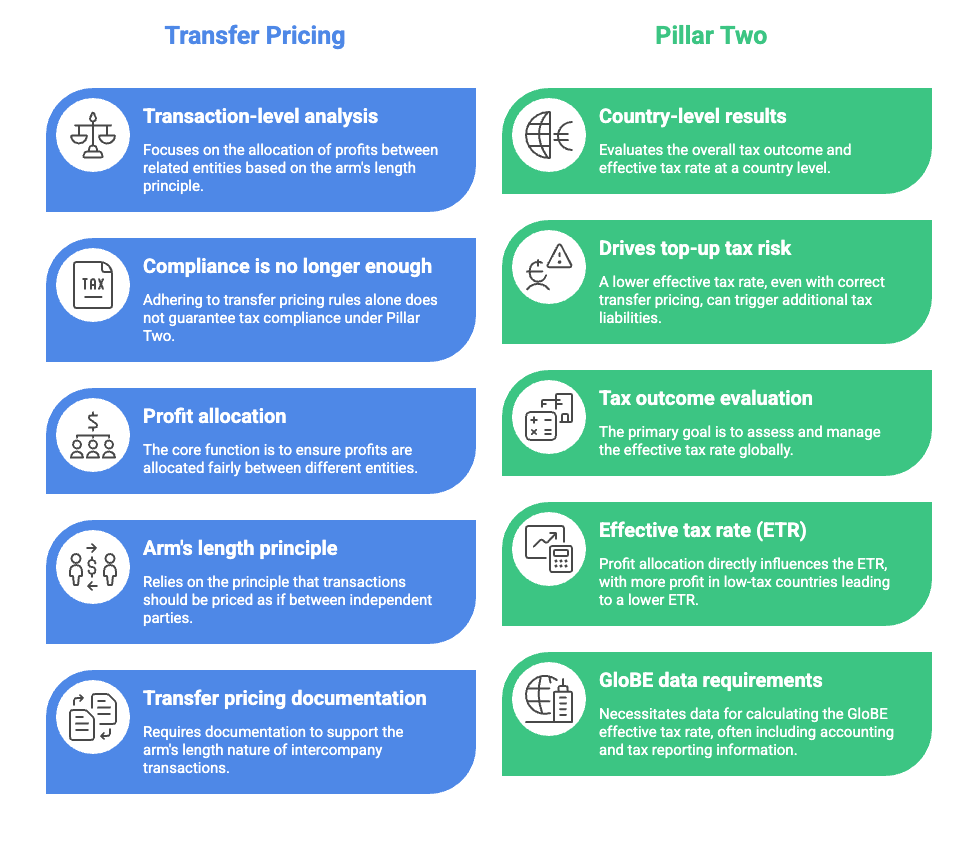
Pillar Two does not rewrite transfer pricing rules, but it changes how their outcomes are evaluated. What used to be the final step in tax compliance is now only the starting point. Transfer pricing still determines where profits are booked, but Pillar Two determines whether the tax applied to those profits is considered sufficient.
This creates a new dynamic. Transfer pricing decisions no longer affect only local tax positions. They now directly influence whether a group will face additional tax under the GloBE rules. As a result, transfer pricing becomes a tool not only for compliance but also for managing the global effective tax rate.
In practice, this means that structures which were historically efficient and fully defensible may now produce unintended results. The focus shifts from isolated transactions to the overall outcome at the jurisdictional level.
Why profit allocation directly affects the ETR
Under Pillar Two, the ETR is calculated separately for each jurisdiction. This means that the amount of profit allocated to a country becomes a critical factor in the outcome of the GloBE calculation. The way in which income is distributed across jurisdictions, whether through transfer pricing policies or structural decisions, directly influences the measured ETR.
The logic is simple but significant. If more profit is allocated to a jurisdiction with a lower tax rate, the overall ETR for that jurisdiction decreases. This increases the likelihood that the jurisdiction will fall below the minimum threshold established under Pillar Two, thereby triggering a top-up tax.
For example, if we consider a structure where a principal entity is located in a low tax jurisdiction and receives a large share of group profits. From a transfer pricing perspective, this may be justified based on the economic substance such as functions, assets, and risks. However, under Pillar Two, this concentration of profit reduces the ETR in that jurisdiction and may trigger top-up tax.
What is important here is that Pillar Two does not question whether the allocation is correct. It simply evaluates the tax outcome of that allocation. This creates a situation where two parallel realities exist:
- Transfer pricing confirms that profits are allocated according to arm’s length principle,
- Pillar Two determines that those profits are not taxed enough.
This is why managing profit allocation is no longer only about defending positions. It is also about understanding how those positions translate into ETRs across jurisdictions.
Why arm’s length compliance alone is no longer sufficient
For decades, the arm’s length principle has been the foundation of transfer pricing. If intercompany transactions were priced in line with market conditions, the structure was considered compliant.
Pillar Two introduces a different perspective. It does not replace the arm’s length principle, but it adds an additional requirement. This creates several practical consequences.
- First, compliance and tax efficiency are no longer aligned by default. A structure can be fully compliant and still lead to additional tax. This challenges the traditional assumption that following transfer pricing rules is enough to manage international tax exposure.
- Second, the focus shifts from individual transactions to aggregated results. Transfer pricing analysis often looks at specific entities or transactions. Pillar Two, by contrast, evaluates the overall position of a jurisdiction. This means that small differences across multiple entities can accumulate and affect the final effective tax rate.
- Third, timing differences and accounting adjustments become more important. Because GloBE calculations rely on financial accounting data, temporary differences between accounting and tax can distort the effective tax rate. These effects are often not visible in standard transfer pricing analysis.
In practice, this means that businesses need to move from a purely compliance-driven approach to a more integrated model. Transfer pricing, tax reporting, and financial data must be considered together, not separately. Without this alignment, even well-structured and documented arrangements can lead to unexpected outcomes under Pillar Two.
Transfer pricing documentation and data under Pillar Two
One of the most significant changes introduced by Pillar Two is the increased importance of data consistency. In the past, transfer pricing documentation, financial reporting, and tax calculations could be prepared with a degree of separation. Under the GloBE rules, this is no longer possible.
The ETR calculation depends on data drawn from multiple sources. If these sources are not aligned, the results may be inaccurate or difficult to defend. As a result, documentation is no longer only about supporting transfer pricing positions. It becomes a key element in ensuring that GloBE calculations are correct.
How CbCR is used in GloBE calculations
CbCR plays a new and more operational role under Pillar Two. Originally designed as a risk assessment tool for tax authorities, it is now used directly in the application of the safe harbour test.
In simplified terms, CbCR data can be used to determine whether a jurisdiction qualifies for simplified treatment.
If certain thresholds are met, a company may avoid full GloBE calculations for that jurisdiction, at least temporarily, in the transitional phase.
However, this creates a new level of sensitivity around CbCR data. Figures that were previously used only for high-level risk assessment now have direct consequences for tax calculations. Any inconsistency between CbCR, financial statements, and transfer pricing documentation can lead to:
- loss of access to safe harbour relief (i.e., Safe harbour follows “Once out, always out” principle – if the safe harbour condition is not applied to a jurisdiction in the first year it falls within the scope, it cannot be used later),
- incorrect assessment of the ETR,
- increased tax audit risk.
This makes the accuracy and internal consistency of CbCR data crucial.
Why consistent and up to date documentation is critical
Under Pillar Two, documentation is no longer static. It must reflect the actual financial and operational reality of the business in a way that is consistent across all reporting layers.
Transfer pricing documentation continues to play a central role, but its function expands. It must now:
- align with financial accounting data used in GloBE calculations
- reflect the same allocation of profit as reported in CbCR
- be updated regularly to capture changes in business models and structures
Outdated or inconsistent documentation can create practical problems. For example, if transfer pricing documentation supports a certain profit allocation, but financial data shows a different result, this discrepancy can affect the ETR calculation.
In addition, tax authorities are increasingly likely to review CbC-reports and Pillar Two calculations together. This means that inconsistencies that were previously overlooked may now become focal points in audits.
In practice, companies need to establish processes that ensure continuous alignment between:
- transfer pricing policies
- financial reporting
- tax calculations
This requires coordination across multiple functions, including tax, finance, and accounting. Without this coordination, the risk is not only non-compliance, but also paying more tax than necessary due to avoidable inconsistencies.
Where the main risks may arise
The initial phase of Pillar Two was about understanding the rules. The current phase is about identifying where those rules create real exposure.
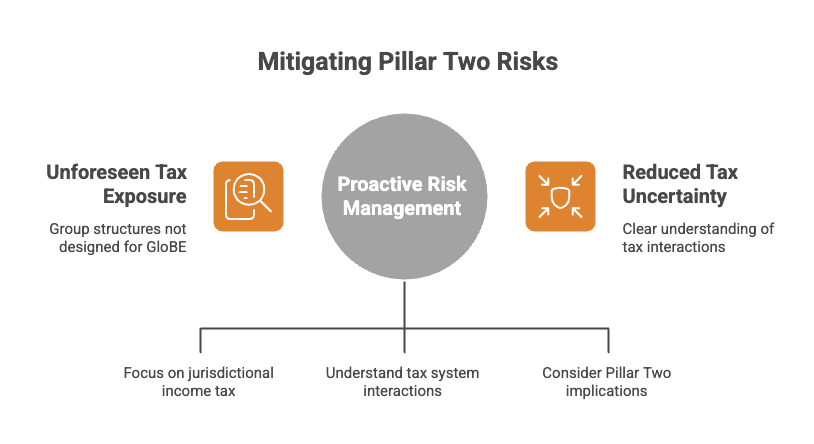
In practice, most risks do not come from aggressive tax planning. They arise from structures that were fully acceptable in the past but were never designed with the GloBE ETR in mind. As a result, many companies are now facing challenging tax outcomes that do not reflect their original expectations.
Financing structures and intangible assets under scrutiny
Intra-group financing is one of the particularly affected areas.
Historically, the focus was on whether interest rates were arm’s length. Under Pillar Two, the focus shifts to where the income is taxed. If interest income is concentrated in a low tax jurisdiction, this can reduce the ETR and may trigger a top-up tax, even where the pricing itself is fully defensible.
Intangible assets create an even more pronounced effect.
IP structures often result in the allocation of high-margin income to specific entities. While such outcomes may be consistent with transfer pricing principles, they can lead to a concentration of profits in jurisdictions with lower taxation. Under Pillar Two, this directly impacts the jurisdictional ETR and increases exposure.
The key point is that the rules do not challenge the structure itself. They change the outcome of that structure.
Risks of double taxation and structural mismatches
A growing concern is the emergence of economic double taxation driven by structural mismatches.
Pillar Two can impose additional tax based on the ETR, while the same income may already be taxed under domestic rules in another jurisdiction. Although mitigating mechanisms exist within the GloBE framework, they do not fully eliminate this overlap.
This risk becomes more visible in structures involving differences in income recognition, tax base determination of the treatment of taxes across jurisdictions.
In addition, existing tools such as advance pricing agreements (APAs) do not fully address Pillar Two implications. A structure may be agreed from a transfer pricing perspective and still result in a top-up tax.
For many MNEs, this creates a new layer of uncertainty. Managing this risk requires not only technical analysis but also a clear understanding of how different tax systems interact in practice.
How T1 Advisory supports companies navigating Pillar Two and transfer pricing
Pillar Two is not difficult because of the rules in isolation. Rather, its challenge lies in the way it brings together tax, accounting and legal frameworks that were not originally designed to operate in an integrated manner.
For companies that are still building internal capabilities, we provide interim support to manage calculations, documentation, and interactions with tax authorities with regard to Pillar Two compliance.
Frequently Asked Questions
1. How does Pillar Two affect transfer pricing in practice?
Pillar Two does not change transfer pricing rules, but it changes their outcome. Profit allocation now directly impacts the ETR and can trigger additional tax even if the structure is compliant.
2. Why can a company face additional tax despite being transfer pricing compliant?
Because Pillar Two evaluates whether profits are taxed at a sufficient level. Even correct arm’s length pricing can result in a low ETR and lead to a top-up tax.
3. What is the safe harbour test and when can it be used?
The safe harbour test allows companies to rely on simplified calculations based on transitional CbCR data, but only if certain thresholds and data consistency requirements are met.
4. What data is required for GloBE ETR calculations?
The calculation uses financial accounting data, tax expense information, and elements from transfer pricing documentation. All of these must be consistent across jurisdictions.
5. Why is CbCR becoming more important under Pillar Two?
CBCR data is now used in safe harbour tests, meaning inaccuracies or inconsistencies can affect both compliance and tax outcomes.
6. Which structures are most exposed to Pillar Two risks?
Structures involving low tax jurisdictions, centralized IP ownership, and intra-group financing are the most exposed due to their impact on the ETR.
7. Can Pillar Two lead to economic double taxation?
Yes, especially where different jurisdictions apply overlapping rules or where treaty protection is limited, creating situations where the same income is taxed more than once.
8. How can companies manage their GloBE ETR effectively?
By aligning transfer pricing, financial data, and tax reporting, and by regularly reviewing how profit allocation affects the ETR across jurisdictions.
9. When should a company consider interim support for Pillar Two?
Interim support is especially valuable when internal teams are not yet fully aligned or when companies need immediate assistance with calculations, documentation, or risk assessment.
