


Transfer Pricing of Intangibles: Valuation Methods, DEMPE Analysis, and Exit Tax Risks
Intangible assets play a critical role across all sectors of the modern economy. According to the World Intangible Investment Highlights 2025, co-published by the World Intellectual Property Organisation (WIPO), intangible investment grew well over three times faster than tangible investment between 2008 and 2024. Moreover, investment in intellectual property (IP) as a share of GDP has been steadily growing over time, making intangibles an important part of economic growth.
Today, a patent, a software platform, or a brand can be legally owned in one country while being exploited and used for value creation elsewhere. Transfer pricing of intangibles is built around resolving this tension and aligning legal ownership with the underlying economic reality.
In practice, this goes well beyond assigning rights on paper. It requires a careful transfer pricing analysis of the Development, Enhancement, Maintenance, Protection and Exploitation of intangibles, the so-called DEMPE analysis. This ensures a defensible valuation of intangibles and a clear understanding of how future cross-border IP transfers may lead to exit tax implications.
This also explains why the same IP can produce very different tax outcomes depending on where it is located. The result is shaped by how transfer pricing of intangibles is approached, how DEMPE functions are allocated, and how well the valuation reflects the actual contribution of each entity.
When these elements are not aligned, even well-structured transactions can attract scrutiny.
In cross-border IP transfers, this often means that what appears commercially reasonable at first glance may still lead to adjustments or unexpected exit tax consequences if the analysis does not fully reflect how value is created within the group.
Why transfer pricing of intangibles matters today
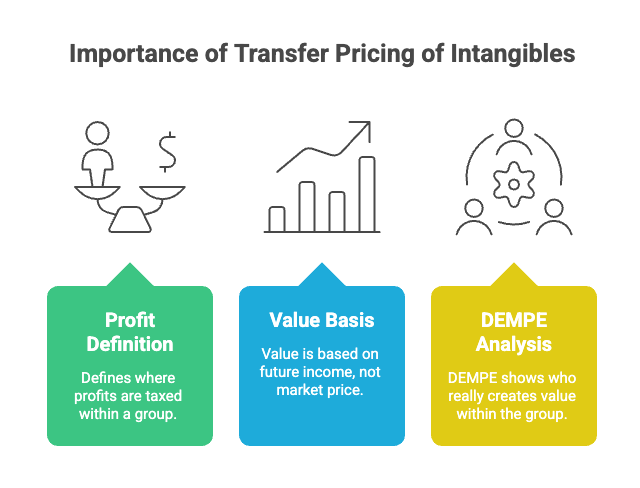
Transfer pricing of intangibles determines where profits appear within a group and whether those profits can be supported if reviewed.
When IP is used or moved through cross-border IP transfers, the focus quickly turns to the valuation of intangibles and whether it reflects how the business actually operates. Unlike physical assets, intangibles do not have a clear market price, so their value is usually based on expected future returns which leaves room for interpretation.
This is why a proper DEMPE analysis is so important. Tax authorities look at who actually develops, improves, and uses the intangible, not just who owns it on paper. If profits are allocated to an entity that does not perform these functions, the structure can be questioned. The same applies when IP is relocated abroad, since such transfers may trigger exit taxation.
In simple terms, everything needs to fit together. The way profits are allocated, how DEMPE functions are distributed across group entities, and how the valuation of intangibles is performed should all reflect the real activity of the business. If they do not, intangibles become an area where transfer pricing risks tend to appear first.
Understanding intangibles in a transfer pricing context
How the OECD defines intangibles in practice
In practice, most issues with intangibles start with a misunderstanding of what actually qualifies as one.
From a transfer pricing perspective, an intangible is not just something nonphysical or a financial asset. It must have independent economic value and be something that unrelated parties would be willing to pay for. Being more specific, the use or transfer of the intangible should be compensated the same as it had occurred in a transaction between unrelated parties under comparable circumstances. Since transfer pricing concepts require going beyond legal labelling, intangibles may not always be identical with intangibles for legal and accounting purposes.
For example, a company may believe that its strong market position is an intangible asset. However, if that value cannot be separated and transferred, it will not be treated as an intangible for transfer pricing purposes.
For transfer pricing purposes, the aspects that may be used in defining intangibles are:
- lack of physical substance,
- non-monetary character,
- identifiability,
- separability,
- controllability,
- future economic relevance or utility,
- different conceivable forms of ownership.
In most cases, the following assets fall within scope:
- licenses and similar limited rights in intangibles,
- proprietary technology and patents,
- software and algorithms,
- brands and marketing intangibles (designs, trademarks),
- customer relationships and data,
- know-how,
- trade secrets.
Identifying the asset is only the starting point. The more important question is who is entitled to the income it generates.
Legal ownership versus value creation
This is where transfer pricing analysis becomes more demanding.
Legal ownership is usually clear. It is supported by registrations, contracts, and formal rights. However, this alone does not determine who should receive the returns.
Tax authorities focus on where value is actually created.
In such cases, the legal owner of the IP cannot automatically claim the full profit.
The legal owner may still receive a return, for example, for providing funding or coordinating activities. However, the larger share of income must go to the entities that actually perform the key functions, employ considerable assets, and manage the risks.
This is where many structures become vulnerable. They are consistent on paper, but not in terms of real activity.
The greater the gap between legal ownership and actual value creation contribution, the higher the likelihood of adjustments.
DEMPE Analysis as the key to allocating value within a group
How DEMPE functions shape profit allocation
DEMPE is often presented merely as a framework, but in practice, it is a tool that explains how value is built and sustained.
It focuses on five areas: Development, Enhancement, Maintenance, Protection, and Exploitation.
The key is not simply identifying where these functions take place. The real question is who performs them and who bears and has the economic capacity to control the associated risks.
For example, an entity may fund the development of an intangible. That alone does not justify receiving the main share of profit.
To do so, it must also:
- Make the key decisions,
- Control the direction of the project,
- Have the capability to manage risks.
If these elements are missing, the return is typically limited.
Another important point is exploitation. Even if an intangible is developed in one location, the way it is used commercially can shift part of the value elsewhere.
DEMPE connects all of this. It ensures that profit allocation follows actual business activity, not just legal arrangements.
Approaching the valuation of intangibles
Choosing the right method in real business situations
In theory, several transfer pricing methods can be applied. In practice, the choice is usually driven by the nature of the intangible and the available data.
One of the most common issues is selecting a method because it is easier to document, rather than because it reflects the underlying transaction.
In reality:
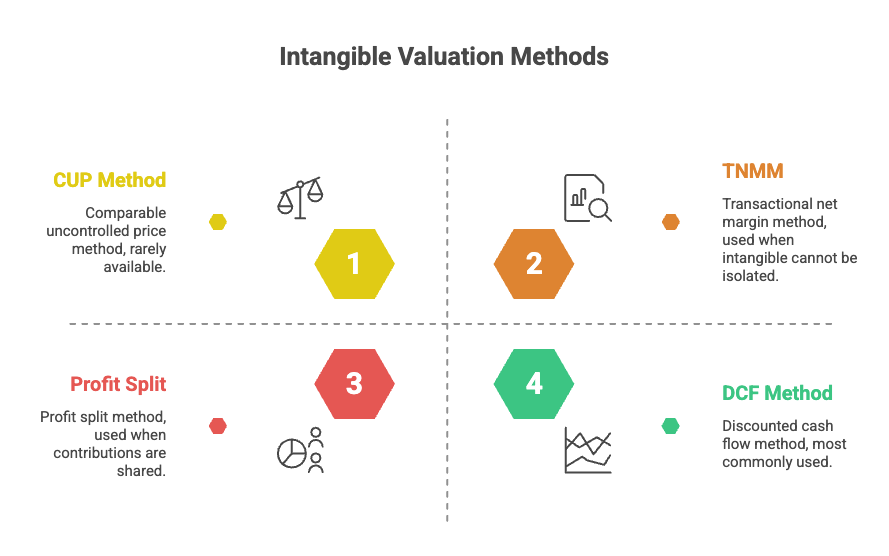
- The Comparable Uncontrolled Price (CUP) method (internal and external CUP) as most direct valuation method. Hence, it is rarely available due to a lack of reliable comparables,
- The Transactional Net Margin Method (TNMM) is often used when the intangible cannot be isolated,
- The Profit Split method becomes relevant when contributions are shared and interdependent. However, it carries higher levels of complexity and subjectivity.
The central question is always the same. Does the method reflect how the income is actually generated?
If it does not, even a technically correct approach may not hold under tax review. Often, various economic valuation approaches are used to assess the value of intangible assets transferred between related parties. In general, all accepted valuation methods depend on realistic and reliable assumptions regarding financial forecasts, growth expectations, discount rates, useful lifespans, and tax implications.
Why the discounted cash flow method is often preferred
When dealing with unique or high-value intangibles, the valuation often comes down to the discounted cash flow method (DCF).
The DCF method focuses on future income and converts it into present value. It is widely used because it captures the economic potential of the asset.
At the same time, it is highly sensitive to assumptions.
Key drivers include:
- expected revenue linked to the intangible,
- growth projections,
- useful life of the asset,
- discount rate reflecting risk.
Small changes in any of these inputs can significantly affect the outcome.
For this reason, the focus is not only on building the model, but on ensuring that the assumptions are consistent with:
- the DEMPE profiles of all involved parties,
- the business model, and
- actual market conditions.
A valuation is only as strong as the logic behind it. If projected returns are not supported by real functions and risks, the result becomes difficult to defend.
A robust valuation aligns financial modelling with how value is truly created within the group. In addition, there are several approaches for applying an income-based valuation technique, such as: incremental cash flow method, relief-from-royalty method, premium profit method, excess earnings method, and residual value method.
Where transfer pricing risks most often arise
Even well-structured IP models tend to face challenges not in theory, but at the moment when intangibles are actually moved, shared, or monetized. This is where assumptions are tested against real transactions.
Certain types of arrangements consistently attract closer attention.
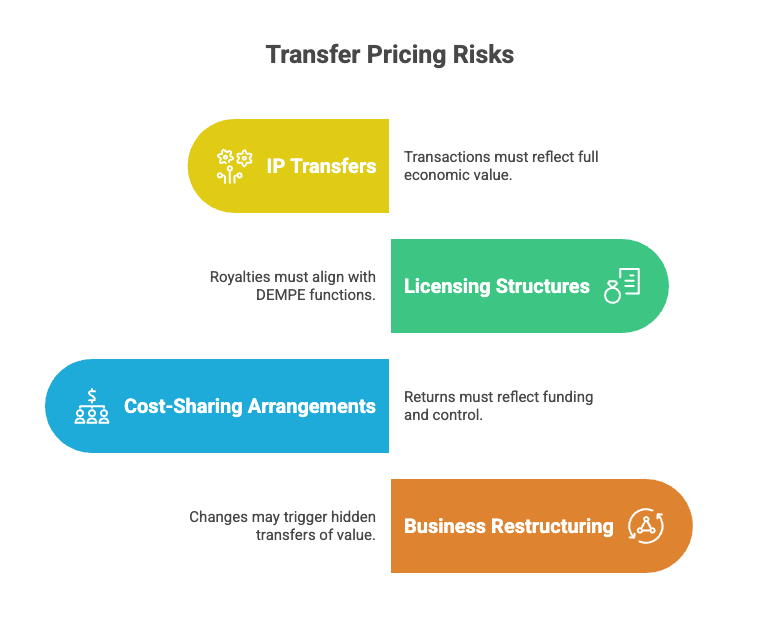
IP transfers within a group are one of the most sensitive areas.
When ownership of an intangible is transferred between related entities, the transaction must reflect its full economic value at that moment. If the valuation of intangibles is understated or based on overly optimistic assumptions about risk, the adjustment can be significant.
Licensing structures often appear more straightforward, but they raise a different set of questions.
The key issue is whether the royalty reflects:
- The actual contribution of the licensor
- The DEMPE profile of both parties
- And the expected benefit for the licensee
A royalty that is disconnected from these elements may look consistent contractually, but it becomes difficult to defend in substance.
Cost-sharing arrangements (also known as Cost Contribution Agreements) introduce another layer of complexity.
Here, multiple entities contribute to the development of an intangible and expect to share in its future returns. The challenge lies in aligning contributions with expected benefits. If one participant funds development but does not control the associated risks, its expected return may need to be adjusted.
Business restructurings and IP migration often combine several of these risks at once.
When DEMPE functions, important assets, or risks are relocated, the question is not only how to price the transaction, but whether something of value has been transferred implicitly.
A restructuring may appear operational, but from a transfer pricing perspective, it can involve:
- A transfer of intangible value,
- A reassessment of DEMPE functions,
- And a need for a full valuation exercise.
These situations require a clear narrative that connects the business rationale with the pricing outcome.
Exit taxation and the transfer of intangible assets across borders
When the exit taxation becomes relevant
The exit tax is triggered when an intangible is moved from one jurisdiction to another, thereby excluding it from the tax base of the original country.
From a tax authority perspective, this is treated as a deemed sale at market value, even if no actual transaction takes place.
This is why the exit tax is closely linked to the valuation of intangibles. The tax base is typically determined by the difference between:
- the fair market value of the intangible at the time of transfer and
- its tax book value.
The higher the estimated future income potential, the higher the exit tax exposure.
In practice, the exit tax becomes relevant in situations such as:
- migration of IP to another jurisdiction
- transfer of DEMPE functions,
- changes in the tax residence of an entity holding IP
What makes this particularly challenging is timing. The tax is often triggered at the moment of transfer, while the economic benefit of the intangible will be realized over time.
This creates immediate cash flow implications and increases the importance of having a well-supported valuation.
How different jurisdictions approach exit taxation
While the concept of exit tax is widely accepted, its application varies across jurisdictions.
In Germany, exit taxation is well established and can apply when assets, including intangibles are moved in a way that restricts or eliminates Germany’s taxing rights. Payment may be deferred under specific regime and facts, but the valuation itself is closely scrutinized.
In Luxembourg and the Netherlands, exit tax regimes are aligned with EU Anti-Tax Avoidance Directive principles. Deferral options are generally available for transfers within the EU, but they are often subject to conditions and ongoing monitoring.
The United Kingdom applies exit tax rules in the context of transfers of assets or in a certain corporate contexts, incl. when a company ceases to be UK resident or transfers assets into or out of a permanent establishment. The focus is on ensuring that any value created within the UK tax base is appropriately captured before the taxing rights are lost.
In the United States, comparable exit tax concepts appear in different forms, including rules applicable to outbound transfers of IP under IRC §367 (d). These rules often rely on projected income streams, which again brings the income-based valuation approaches into focus.
Despite these differences, a common theme remains: tax authorities expect the valuation of the transfer packages to reflect realistic assumptions and economic substance.
How T1 Advisory supports businesses in managing intangible transfer pricing
Working with intangibles requires more than technical compliance. It requires a clear understanding of how business decisions translate into transfer pricing outcomes.
What makes these projects complex is not the regulation, but the need to connect multiple elements into a consistent position.
- The functional profile of each entity,
- The financial modelling behind the valuation,
- And the legal and operational structure of the group.
We focus on making these elements work together. In practice, this often means revisiting assumptions, refining the DEMPE analysis, and ensuring that the chosen approach can be clearly explained and supported.
FAQ
1. What is transfer pricing of intangibles in simple terms?
It is the process of determining how income related to intellectual property is allocated between companies within the same group across different jurisdictions.
2. What qualifies as an intangible for transfer pricing purposes?
An intangible is an asset with independent economic value that can be controlled and would be compensated if transferred between unrelated parties.
3. Why is DEMPE analysis important?
DEMPE analysis determines which entity actually creates value and therefore should receive the corresponding share of profits.
4. Can a legal owner of IP receive all the profits?
No, profits must reflect actual functions, risks, and decision-making, not just legal ownership.
5. When do cross-border IP transfers become risky?
They become risky when the valuation of intangibles or allocation of DEMPE functions does not match the real business activity.
6. What triggers the exit tax on intangible assets?
Exit tax is triggered when an intangible is moved to another jurisdiction and leaves the tax base of the original country.
7. How is exit tax calculated?
It is usually based on the difference between the market value of the intangible and its tax book value at the time of transfer.
8. Can companies defer exit tax payments?
In some jurisdictions, especially within the EU, the exit tax can be deferred, but usually under strict and specific conditions.
9. How can businesses reduce transfer pricing risks related to intangibles?
By aligning DEMPE functions, valuation of intangibles, and IP transaction structure with actual business operations, and maintaining clear transfer pricing documentation.
