


How Permanent Establishments Are Treated in Transfer Pricing
A remote employee signs contracts from another country. A construction project lasts longer than expected. A regional sales team starts negotiating commercial terms locally instead of through headquarters.
None of these situations automatically creates a permanent establishment (PE). All of them can attract the tax authority’s attention.
PE exposure has become a major issue for multinational enterprises (MNEs) operating across multiple jurisdictions, particularly where cross-border operations evolve faster than internal tax structures. Once authorities start examining where decisions are made, who controls commercial activity, and how profits are allocated, transfer pricing questions usually follow very quickly. A PE in a country triggers the host country’s right to tax the profits attributable to the PE.
In practice, businesses increasingly rely on stronger transfer pricing documentation to support the operational substance behind international structures involving permanent establishments.
Why PEs Have Become a Major Tax Focus
How cross-border operations create PE exposure
Permanent establishment exposure often appears gradually.
A business enters a foreign market through a small sales presence. Employees travel frequently to support negotiations. Local teams begin coordinating suppliers, customer relationships, or operational activity on the ground. At first, none of this looks unusual. Then, tax authorities start asking practical questions about who actually conducts business and what value is generated in that jurisdiction.
The problem usually begins once operational activity becomes difficult to separate from taxable presence.
A regional employee negotiating commercial terms may create different exposure than a support employee handling administrative tasks. A project team remaining on-site for several months creates different risks than short business visits. The details matter, sometimes down to who attended meetings or where contracts were effectively finalized.
Cross-border activity frequently creating PE exposure includes:
- contract negotiations performed locally,
- long-term project presence,
- employees working remotely from another jurisdiction,
- local operational management,
- repeated client-facing activity inside one country.
Many MNEs discover these risks only after operational expansion has already moved ahead faster than internal tax review.
Why do tax authorities pay close attention to permanent establishments
Permanent establishments directly affect where profits become taxable.
For tax authorities, PE cases often involve a larger concern: whether commercial activity takes place in one jurisdiction while profits remain reported somewhere else.
That is why audits increasingly focus on employee activity, operational decision-making, internal reporting lines, and the actual conduct of the business rather than legal forms alone.
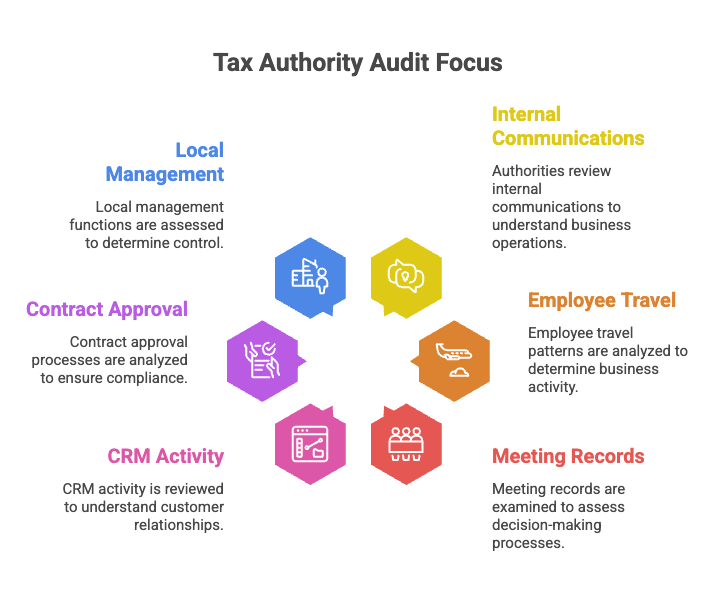
Authorities review and analyze:
- internal communications,
- employee travel patterns,
- meeting records,
- CRM activity,
- contract approval processes,
- local management functions.
A company may formally describe one entity as providing limited support services while employees inside that jurisdiction effectively manage commercial relationships day to day. Situations like this attract attention quickly during audits.
The growing connection between transfer pricing and PE risk
Permanent establishment analysis and transfer pricing discussions usually end up in the same room.
Once a tax authority concludes that a PE exists, the next question becomes financial. How much profit should be attributed to that activity? Which functions were performed locally? Who controlled the risks? Which employees actually drove commercial value?
That is where transfer pricing enters the discussion.
A regional sales operation previously compensated on a routine cost-plus basis may suddenly face questions about whether local personnel performed far more valuable functions than documented internally. A foreign branch supporting procurement activity may appear operationally minor until authorities review who negotiated supplier relationships and controlled purchasing decisions.
How international businesses manage PE-related compliance challenges
Most businesses try to manage PE exposure long before disputes appear.
In practice, that usually involves reviewing:
- employee responsibilities,
- travel activity,
- local authority granted to personnel,
- contract negotiation processes,
- reporting lines between entities,
- operational substance across jurisdictions.
The difficult part is that operational reality tends to shift faster than internal documentation.
A small support presence may gradually become commercially important over several years without anyone formally updating transfer pricing policies, intercompany agreements, or tax reporting assumptions. By the time the issue surfaces during an audit, reconstructing the operational history often becomes far more difficult than the technical tax analysis itself.
What Is a PE?
OECD definition and the core characteristics of a permanent establishment
Most countries base their PE analysis on OECD principles, although local interpretation can differ significantly in practice.
Broadly speaking, a PE refers to a sufficient level of business presence inside another jurisdiction that allows taxation of profits connected to that activity. The analysis usually focuses on three practical questions:
- does the business have a meaningful presence in the country,
- is the activity sufficiently continuous,
- does the local activity contribute directly to commercial operations.
Tax authorities rarely look at one factor in isolation. They review how the business actually functions on the ground.
A company may avoid creating a legal entity in another country and still create PE exposure through employee activity, operational control, or local commercial presence.
Fixed place PE and dependent agent structures
Some PE cases involve physical presence. Others depend almost entirely on people functions.
A fixed place PE often involves:
- offices,
- branches,
- project locations,
- workshops,
- operational facilities used regularly by the business.
However, the existence of a PE is not limited to a physical location.
Dependent agent cases tend to focus on individuals working in a jurisdiction on behalf of the company. The risk becomes much higher once employees or representatives start negotiating or concluding contracts connected to the core business activity, becoming a PE.
In practice, authorities increasingly examine substance over formal titles.
An employee described internally as “business development support” may still create PE exposure if their day-to-day role effectively drives commercial negotiations inside the jurisdiction.
Construction sites, service PEs, and digital business presence
Construction and infrastructure projects receive particularly close attention because timelines matter heavily in PE analysis.
A project initially expected to last several months may cross the threshold creating taxable presence once delays appear, subcontractors remain on-site longer than planned, or operational activity expands beyond the original scope.
Service PE exposure often develops differently. A company may provide consulting, engineering, technical support, or management services inside another jurisdiction through traveling employees over an extended period. Even without permanent office space, repeated physical presence may still create tax exposure depending on local treaty rules.
Digital business activity creates another difficult area.
A company may operate commercially inside a jurisdiction through remote teams, localized market activity, or ongoing digital interaction with customers while maintaining limited formal physical presence there. Tax authorities increasingly examine how commercial activity actually functions rather than relying solely on traditional physical office concepts.
Situations that commonly trigger PE risks
Some PE risks appear repeatedly across industries because operational growth tends to follow similar patterns.
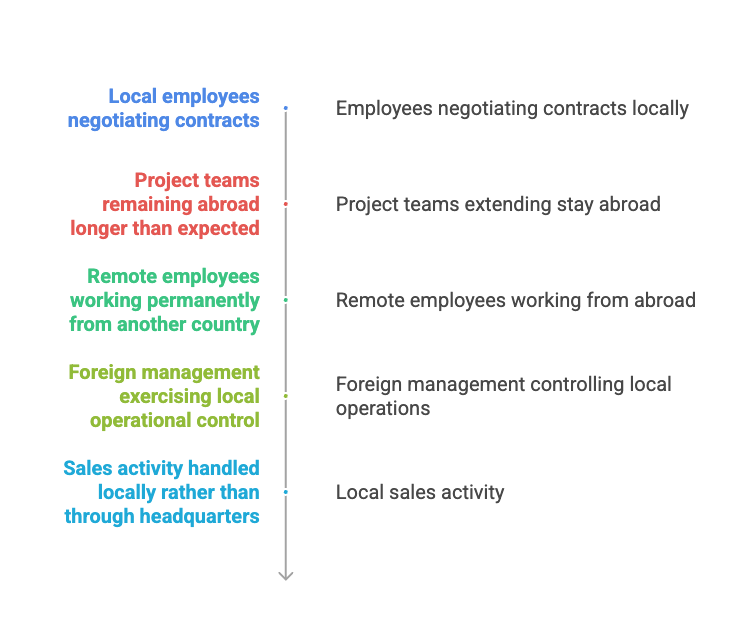
Common triggers include:
- local employees negotiating contracts,
- project teams remaining abroad longer than expected,
- remote employees working permanently from another country,
- foreign management exercising local operational control,
- sales activity handled locally rather than through headquarters,
- long-term service delivery inside one jurisdiction.
The difficult part is that many of these situations develop gradually.
A company rarely decides intentionally to create PE exposure. Most cases begin with operational convenience, commercial expansion, staffing needs, or client pressure. Tax exposure appears later once the business footprint inside the jurisdiction becomes commercially significant.
Why PEs Matter in Transfer Pricing
Once a PE exists, tax authorities analyze it like a separate business operating inside that jurisdiction.
That does not mean the PE becomes legally independent from headquarters, yet it is treated separately for tax purposes. Financially and operationally, however, tax authorities still expect a reasonable portion of profit to follow the activity performed locally.
This is where transfer pricing becomes unavoidable. Transfer pricing involves setting the price for goods, services and intangibles between associated enterprises in different tax jurisdictions following the arm’s length principle.
A PE may not sign contracts independently or own legal title to assets, yet local personnel can still perform economically significant functions connected to sales, procurement, manufacturing support, or operational management. Tax authorities, therefore, examine what the people inside the PE actually contribute to the business rather than relying only on legal ownership.
Functional analysis and the attribution of assets, risks, and people functions
PE analysis depends heavily on performed functions.
Authorities closely examine:
- who negotiates commercially important terms,
- where key operational decisions are made,
- who manages and controls local risks,
- where client relationships are developed and maintained,
- which employees perform revenue-generating activity.
This often creates tension between legal reporting lines and operational reality.
A regional employee may formally report to headquarters while effectively managing customer relationships, supplier negotiations, or project execution inside another jurisdiction. In PE and transfer pricing analyses, those facts carry significant weight.
The practical difficulty is that MNEs often document legal structures far more thoroughly than day-to-day operational conduct. As a result, the documented organizational structure may not fully reflect where economically significant activities are actually performed.
How to allocate profits to a PE under the Authorized OECD Approach
The Authorized OECD Approach focuses heavily on functional analysis.
Tax authorities generally examine what activities a PE performs, which risks it controls, and what assets support those transfer pricing operations. Profit attribution then follows the economic activity connected to those functions.
In practice, this process becomes highly fact-dependent.
Two businesses operating in similar industries may receive completely different PE outcomes depending on:
- employee authority,
- operational decision-making,
- local commercial involvement,
- internal reporting structures,
- control over revenue-generating activity.
Even relatively small operational differences sometimes produce substantial changes in profit attribution.
Intra-group transactions between headquarters and PEs
One of the more technical areas involves transactions between headquarters and the PE itself.
Authorities often examine:
- internal service charges,
- funding arrangements,
- operational support functions,
- intellectual property use,
- procurement activity,
- internal management services.
These intercompany relationships must appear in the same way as transactions between unrelated legal entities, therefore tax authorities expect reasonable economic allocation between headquarters and local activity. Maintaining detailed transfer pricing documentation to support the arm’s length nature of transactions involving PEs. This documentation is crucial during tax audits and disputes.
Common transfer pricing challenges connected to PE structures
PE structures create difficult transfer pricing questions because legal ownership and operational activity are often located in different places.
Common disputes involve:
- profit attribution,
- employee functions,
- internal service allocations,
- operational control,
- local commercial substance,
- inconsistent reporting between jurisdictions.
The operational reality inside MNEs also changes constantly. Employees relocate temporarily. Projects expand. Reporting lines shift. Commercial authority gradually moves closer to customers or suppliers.
Without regular review, transfer pricing documentation can quickly stop matching how the business actually functions across jurisdictions.
Transfer Pricing Documentation for PEs
How PEs should appear in transfer pricing documentation
Permanent establishments usually require much more operational detail in transfer pricing documentation than businesses initially expect.
Authorities generally look for:
- a clear description of local activities,
- employee responsibilities,
- reporting lines,
- operational functions,
- profit attribution methodology,
- financial allocation between headquarters and the PE.
The challenge appears once operational conduct differs from formal documentation. During audits, authorities often compare documentation against emails, contracts, internal reporting systems, and employee activity records.
The role of Country-by-Country Reporting in PE transparency
Country-by-Country Reporting (CbCR) gives tax authorities a broad view of where multinational groups report revenue, employees, profits, and operational activity.
PE structures receive particular attention once:
- local employee presence appears significant,
- revenues connected to one jurisdiction seem disproportionate,
- operational substance and reported profitability diverge,
- local activity appears commercially important despite limited taxable profit.
Documentation expectations during tax audits
PE audits tend to become highly factual very quickly.
Authorities frequently request:
- employee calendars,
- travel records,
- contract approval workflows,
- meeting documentation,
- CRM activity,
- internal communications,
- project timelines.
The purpose is usually straightforward: reconstruct how the business actually operated inside the jurisdiction.
Once operational conduct differs from the formal tax position, defending the original documentation becomes significantly harder.
Why inconsistencies in reporting increase double taxation risks
Double taxation risks increase sharply once jurisdictions interpret the same activity differently.
One country may conclude that a PE exists and attribute additional profit locally. Headquarters may continue reporting the same profit elsewhere. If documentation between jurisdictions lacks consistency, resolving the dispute often becomes lengthy and expensive.
This happens frequently, where:
- operational functions are poorly documented,
- employee authority remains unclear,
- reporting structures changed over time,
- transfer pricing assumptions were never updated after operational expansion.
The importance of accurate operational and financial data
PE analysis depends heavily on operational detail.
Small factual differences often change the outcome:
- where contracts were negotiated,
- how the pricing was established,
- how long employees stayed locally,
- who controlled supplier relationships,
- where operational decisions were made.
Financial allocation alone rarely solves these cases.
Tax authorities increasingly expect documentation capable of connecting operational activity, employee conduct, reporting structures, and financial outcomes into one consistent explanation of how the business actually functioned across jurisdictions.
Permanent Establishments and Pillar Two Compliance
How PEs are treated under the GloBE Rules
Under the GloBE Rules, permanent establishments are generally treated as separate constituent entities (CEs) for Pillar Two purposes. That means profits, taxes, and operational activity connected to the PE may need to be analyzed separately from headquarters, depending on the jurisdictional setup.
In practice, this creates additional complexity for large multinational groups already managing transfer pricing and PE documentation across several countries.
The issue becomes especially sensitive where local profit attribution differs from the way the group historically reported income internally.
Effective Tax Rate calculations and jurisdictional blending
Effective Tax Rate (ETR) calculations under Pillar Two depend heavily on how income and covered taxes are allocated between jurisdictions.
Once PEs are present the picture, businesses often face difficult questions around:
- which jurisdiction should recognize the income,
- where taxes should be attributed,
- how local losses affect ETR calculations,
- whether profit allocation remains consistent across reporting systems.
Even relatively small differences in PE treatment may influence jurisdictional blending outcomes under the global minimum tax framework.
Why PE structures complicate Pillar Two compliance
PEs create additional reporting layers inside multinational tax structures.
A group may already manage:
- local corporate entities,
- branch operations,
- regional service hubs,
- cross-border employee activity,
- centralized management functions.
Once Pillar Two calculations are added, businesses often need to reconcile operational activity, transfer pricing outcomes, local tax treatment, and GloBE reporting simultaneously.
The practical difficulty is that PE analysis tends to rely heavily on factual operational details, while Pillar Two reporting requires consistent financial allocation across jurisdictions.
Cross-border allocation challenges under Global Minimum Tax rules
Profit allocation becomes much more sensitive once multiple jurisdictions review the same activity under different tax frameworks.
One country may attribute substantial profit to a PE based on local operational functions, while another jurisdiction may continue treating the same income differently for domestic tax or reporting purposes.
These inconsistencies create pressure around:
- tax allocation,
- deferred tax treatment,
- local profitability calculations,
- jurisdictional reporting consistency.
The more cross-border operational activity a group manages, the harder these allocations usually become.
Reporting difficulties for multinational groups with multiple PEs
Large multinational groups sometimes operate dozens of branch structures across different jurisdictions simultaneously.
The reporting challenge is rarely limited to tax calculations alone. Businesses must also track:
- employee activity,
- local operational functions,
- internal reporting lines,
- branch financials,
- intercompany allocations,
- local filing obligations.
Once reporting systems between jurisdictions stop aligning, inconsistencies tend to appear very quickly during audits or Pillar Two reviews.
Risks Associated With Permanent Establishments
Double taxation exposure and conflicting tax authority positions
Double taxation remains one of the biggest risks connected to PEs.
One jurisdiction may conclude a PE exists and attribute additional profit locally, while the headquarters continues reporting the same income elsewhere. If tax authorities disagree on profit allocation, businesses can end up taxed twice on the same activity.
These disputes often become difficult because PE analysis depends heavily on operational facts rather than purely legal interpretation.
Unrecognized permanent establishments and hidden compliance risks
Some PE risks remain unnoticed for years.
A remote employee gradually takes on commercial responsibilities abroad. A local project expands beyond its original timeline. Regional personnel begin negotiating contracts informally while headquarters still treats the jurisdiction as low-risk from a tax perspective.
At that point, the tax exposure may already involve:
- unpaid corporate tax,
- penalties,
- interest,
- historical reporting corrections.
Transfer pricing disputes connected to profit attribution
Once a PE is identified, disputes usually shift toward profit attribution.
Authorities examine:
- who controlled commercial activity,
- where decisions were made,
- which employees generated value,
- whether local functions received appropriate remuneration.
These cases become particularly sensitive where local operational substance appears stronger than the transfer pricing documentation originally suggested.
Penalties linked to insufficient documentation
Weak documentation creates problems quickly in PE cases because authorities often rely on operational evidence gathered during audits.
If businesses cannot clearly explain:
- employee responsibilities,
- reporting structures,
- contract negotiation processes,
- local decision-making authority,
- financial allocation methodology,
tax authorities may challenge both the existence of the PE and the amount of profit attributed to it.
Operational risks caused by fragmented reporting structures
Many PE disputes begin internally long before audits appear.
Operational teams expand into new jurisdictions while tax reporting remains unchanged. HR systems track employee locations differently from finance departments. Legal agreements fail to match commercial activity on the ground.
Over time, fragmented reporting creates inconsistencies between:
- operational conduct,
- transfer pricing documentation,
- payroll records,
- tax filings,
- internal reporting systems.
Once authorities start comparing those records side by side, defending the overall position becomes difficult.
Best Practices for Robust PE Documentation
Mapping business activities and decision-making functions
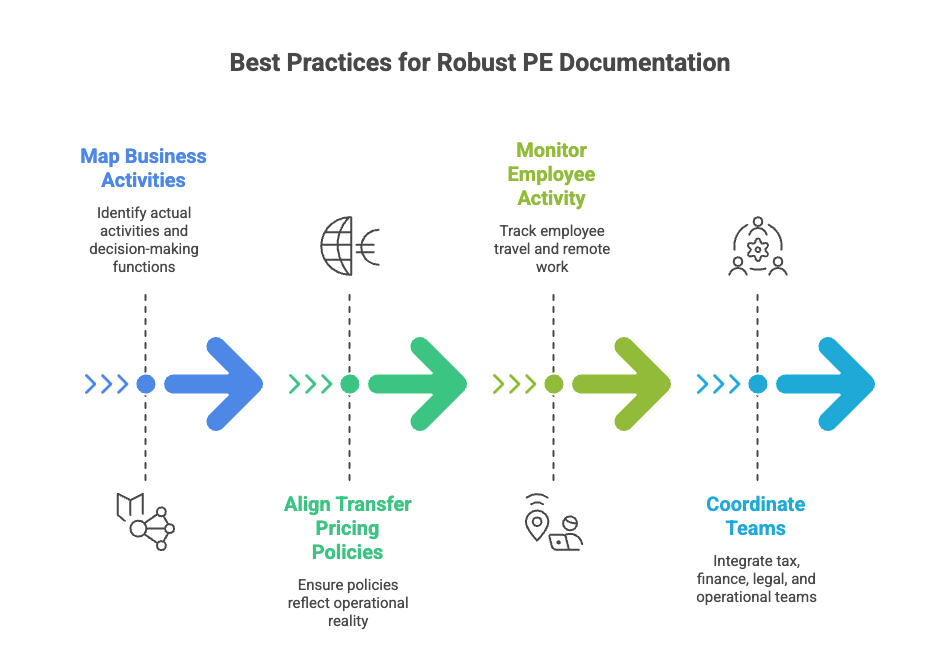
Permanent establishment analysis depends heavily on what people actually do inside the business.
A company may formally describe local activity as “support” while employees inside that jurisdiction negotiate contracts, manage suppliers, supervise projects, or make operational decisions day to day. During audits, tax authorities usually focus on practical business conduct rather than internal labels.
That is why businesses need a detailed understanding of:
- where commercial decisions are made,
- who controls operational activity,
- which employees interact with customers or suppliers,
- how local teams participate in revenue-generating functions.
Even small factual details may change the PE analysis significantly.
Aligning transfer pricing policies with operational reality
Transfer pricing policies often remain unchanged long after operational activity has shifted across jurisdictions.
A regional office may gradually become commercially important while documentation still treats it as a low-risk support function. Project teams may take on broader authority locally without corresponding changes in profit attribution or internal agreements.
Over time, these gaps become highly visible during audits.
Businesses usually face fewer problems when transfer pricing documentation reflects the actual conduct of employees, operational reporting lines, and day-to-day commercial activity rather than relying only on historical legal structures.
Monitoring employee activity and cross-border presence
Many PE cases begin with employee activity that initially looks temporary.
A specialist remains abroad longer than expected. A sales employee starts negotiating commercial terms locally. Regional managers begin supervising projects inside another jurisdiction on a regular basis.
Individually, these situations may appear minor. Combined over time, they often create taxable presence concerns.
Businesses increasingly monitor:
- employee travel patterns,
- remote work arrangements,
- project timelines,
- local contract negotiations,
- management authority across jurisdictions.
Without regular review, operational activity may go far beyond the assumptions originally used in tax reporting.
Coordinating tax, finance, legal, and operational teams
PE exposure rarely stays within one department.
Operational teams manage expansion into new markets. HR tracks employee movement. Finance handles reporting allocations. Legal departments review contracts and local registrations. Tax teams often receive fragmented information long after commercial activity has already changed.
This creates inconsistent reporting very quickly.
The strongest PE documentation usually comes from businesses where operational, legal, finance, and tax functions regularly review cross-border activity together rather than separately.
How T1 Advisory Supports Permanent Establishment and Transfer Pricing Compliance
Permanent establishment disputes rarely begin with tax documentation alone.
A project timeline changes. Employees start negotiating locally. Regional management gains broader authority across jurisdictions. Operational activity shifts gradually while transfer pricing policies and reporting assumptions continue following an older structure.
By the time authorities begin reviewing the case, companies often face several years of accumulated exposure.
At T1 Advisory, we support multinational groups with PE and other transfer pricing documentation.
Our work focuses on how the business actually operates across jurisdictions:
- where decisions are made,
- which entities control commercial activity,
- how employee functions changed over time,
- whether profit allocation still reflects operational reality.
We help businesses identify inconsistencies early, strengthen documentation, and align international tax positions with the way value is genuinely created across the group.
Your Questions, Our Answers
1. What creates a permanent establishment risk?
PE risk usually appears when employees, projects, or commercial activity inside another jurisdiction become sufficiently continuous or operationally important.
2. How to allocate profits to a permanent establishment?
Profit allocation generally depends on the functions performed locally, the risks controlled inside the jurisdiction, and the people driving commercial activity.
3. Can a remote employee create a permanent establishment?
Yes, depending on the employee’s authority, responsibilities, and the level of business activity performed from that jurisdiction.
4. Why do permanent establishments increase double taxation risks?
Different jurisdictions may attribute the same profit differently, especially when authorities disagree on the existence or scope of the PE.
5. How are permanent establishments treated under the GloBE Rules?
Under the GloBE Rules, permanent establishments are generally treated as separate CEs for Pillar Two calculations.
6. Do permanent establishments complicate calculations?
Yes, because PE profit allocation and tax attribution may affect jurisdictional ETR calculations under Pillar Two reporting rules.
